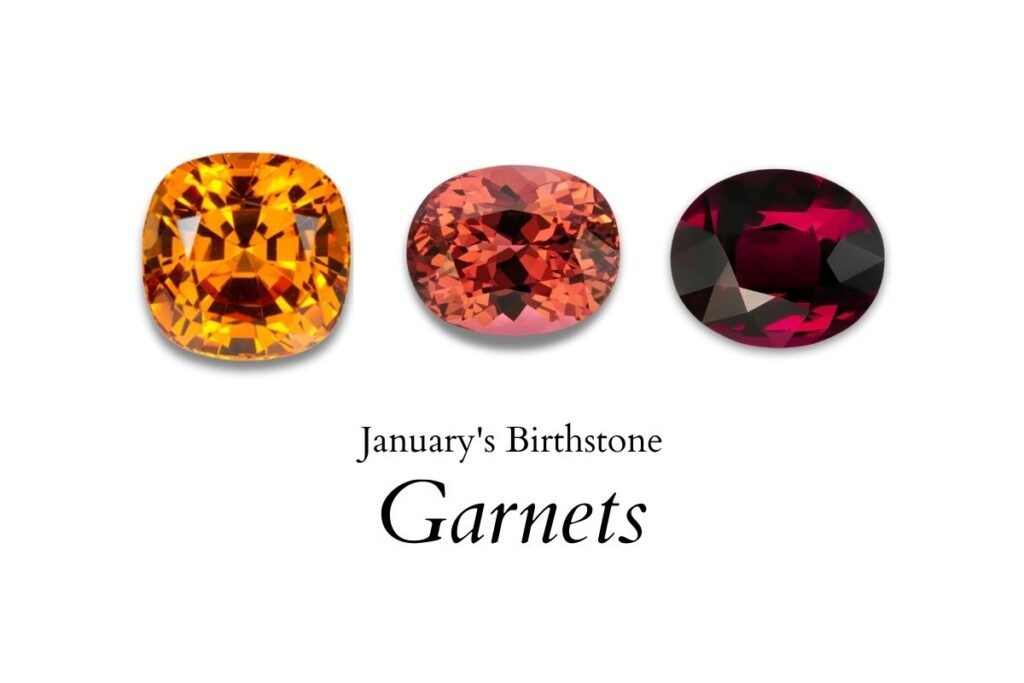
January’s Birthstone: Garnets. Underestimated, deep, powerful.
On protection, passage, and the many colors of endurance.
January has never felt like a beginning to me.
It feels like a threshold.
The world is quiet, stripped back. Light arrives slowly, almost cautiously. In this stillness, garnet appears not as decoration, but as warmth. A held ember. A reminder that life doesn’t restart in January—it continues, deeper underground, gathering force.
I’ve always found it fitting that January is guarded by garnet. Not a pale stone, not a timid one. A mineral that speaks of blood, earth, and survival. Of promises kept through winter.
When I hold a garnet between my fingers, I don’t think first of color. I think of movement. Of travel. Of what protects us when we cross from one state of being into another.
Why January Belongs to Garnet
The association between January and garnet predates the modern birthstone lists by centuries. In ancient calendars, January marked transition rather than renewal—Roman Janus looking both backward and forward. Garnet was worn for precisely that reason.
Across cultures, garnet functioned as a talisman for travelers, soldiers, and those crossing borders—physical or spiritual. Medieval texts describe garnets sewn into garments to protect against injury and illness. In ancient Persia and India, red stones—often almandine or pyrope—were believed to carry the essence of life force itself.
There’s a practical poetry here. Garnets are hard, resilient stones. They survive abrasion. They endure pressure. They don’t fracture easily. January demands the same.
This is not a gemstone of optimism.
It’s a gemstone of continuity.
Garnet Is Not One Stone — It Is a Family
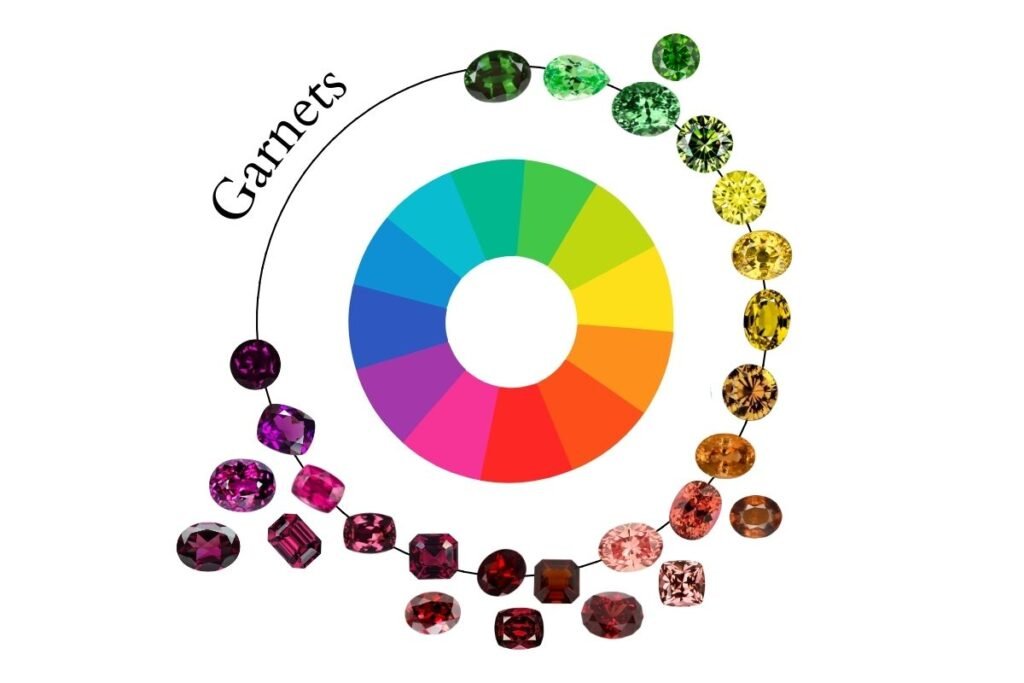
One of the great misunderstandings about garnet is that it is singular. It isn’t.
The name itself comes from the Latin granatus—“seed-like”—a reference to the pomegranate, whose clustered crimson seeds early jewelers believed the stones resembled. This comparison appears already in Roman and medieval texts, where garnets were described not as isolated gems, but as gathered fire—many small points of life held together.
In reality, garnet is a group. A complex family of minerals that share a crystal structure but differ in chemistry, color, and origin. Ancient traders didn’t have modern gemology, yet they understood something essential: that these stones behaved differently depending on where they came from, how they caught the light, how they aged in wear.
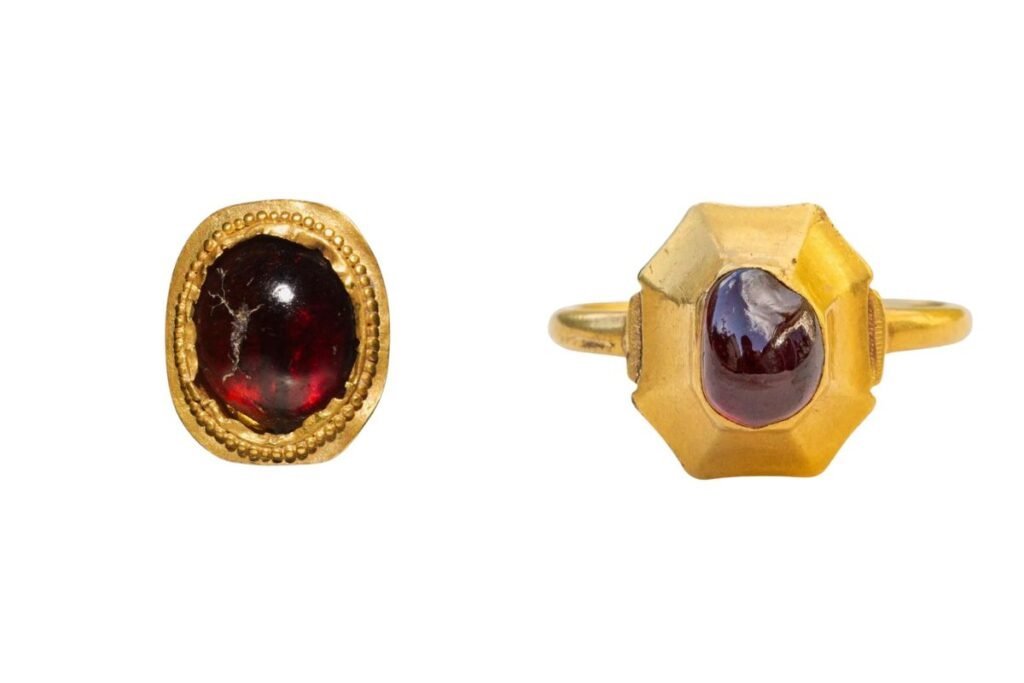
Archaeological garnets have been found in Bronze Age burial jewelry, in Roman intaglios, in Merovingian cloisonné work, and later in medieval reliquaries and royal ornaments. Often set in gold cells, packed tightly together, they were chosen not for brilliance but for permanence. Garnet did not fade, crack, or lose itself to time.
As a gemhunter, this is where garnet becomes endlessly fascinating. The same name holds an entire spectrum of personalities—quiet and dense, luminous and restless, earthy or electric. Garnet has a spectrum for human personality.
I’ll guide you through them the way I learned them—by color, by place, by the way they behave in the light.
Almandine — The Ancestral Red
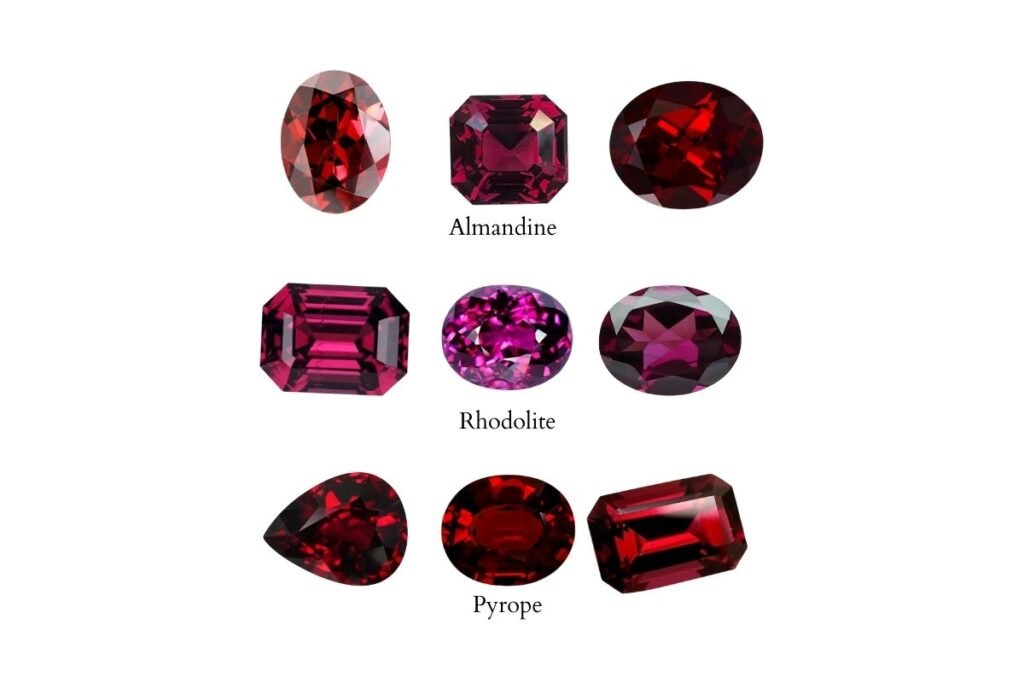
Almandine is what most people unknowingly imagine when they think of garnet. Deep red. Sometimes with brown or violet undertones. Dense, serious, grounded.
Historically, almandine was sourced from India and Sri Lanka, traded along ancient routes into Europe. Many Victorian and Georgian garnet jewels—those heavy, closed-back pieces—are almandine.
Its color is not flamboyant. It absorbs light rather than throwing it back. I think of almandine as velvet rather than silk.
Energetically, almandine has always been associated with grounding and physical protection. It’s the stone of staying alive. Of stamina. Of carrying on.
Almandine itself rarely exists in isolation; many stones sit along a natural spectrum, appearing as almandine–pyrope, almandine–rhodolite, or rhodolite–pyrope, their hue shifting subtly with chemistry and origin.
Pyrope & Rhodolite — Fire With Breath
Pyrope shifts the red toward fire—cleaner, brighter, often with a subtle glow from within. When pyrope mixes with almandine, rhodolite appears: raspberry, rose, sometimes leaning toward purple.
Rhodolite garnets from Mozambique and Tanzania are among my favorites. The best ones have a luminous quality, like light passing through a glass of red wine at dusk.
These stones feel more emotional than almandine. Still protective, but with openness. Historically, pyrope garnets were worn by warriors; rhodolite feels more like the heart after battle.
Alive, but changed.
Spessartite — The Spark of Joy
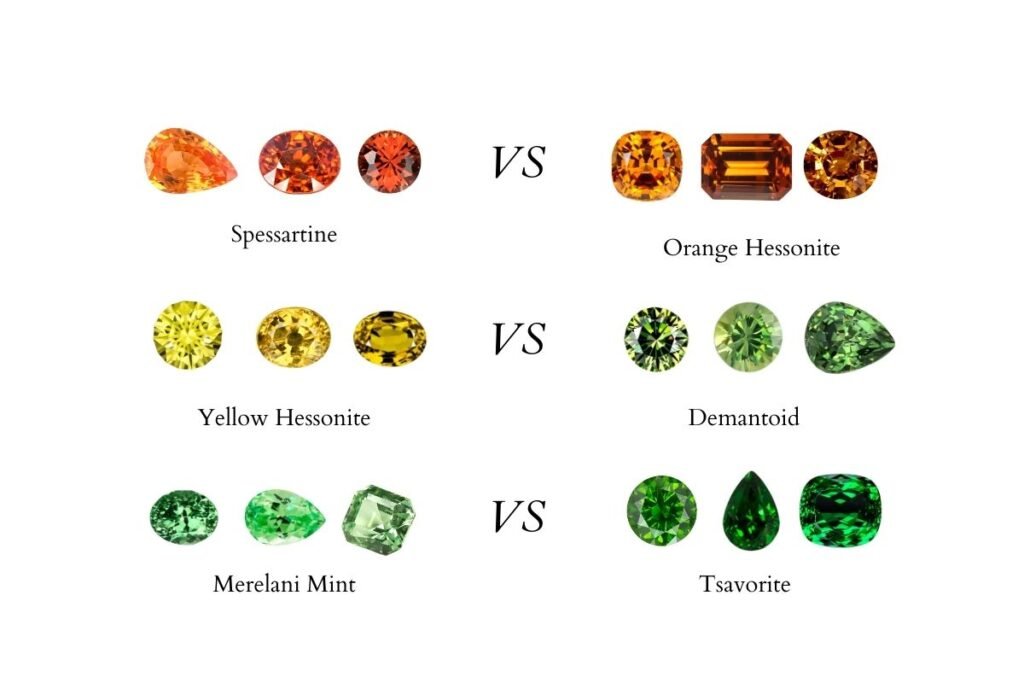
Spessartite garnet breaks the myth that garnets must be red. Vivid orange. Mandarin. Sometimes coppery, sometimes almost neon.
The finest spessartites come from Namibia and Nigeria. Their color can be shocking in the best sense—pure saturation, no hesitation.
If red garnets speak of survival, spessartite speaks of vitality. Of appetite. Of desire returning after dormancy.
In January terms, spessartite is the moment you realize you’re still capable of wanting.
Grossular — The Chameleon of the Garnet Family
Grossular garnet is the most quietly surprising member of the family. Unlike the reds that dominate garnet’s public imagination, grossular moves through a wide palette—fresh green, honeyed yellow, cinnamon brown, soft peach, even near-colorless. Tsavorite belongs to this species, but it is only one expression of it.
Green grossulars range from pale, spring-leaf tones to saturated, forest depths, depending on trace elements and origin. Yellow and orange grossulars—often called hessonite when their warm, spiced color leans toward amber—carry a softness, almost a glow rather than a flash. Some stones show a milky translucence, others a crisp clarity that feels unexpectedly modern.
Historically, grossular was valued not for drama but for harmony. In antique jewelry, it appears in carved forms, cabochons, and understated settings—stones chosen to sit close to the skin. Energetically, grossular has long been associated with balance, nourishment, and steady growth. It doesn’t demand attention. It sustains it.
Grossular reminds me that garnet isn’t defined by intensity alone. It is defined by adaptability—by its ability to carry color, light, and meaning in many voices, without losing its identity.
Tsavorite — Green Without Softness
Tsavorite garnet is a geological miracle and a variety of grossular garnet. Discovered in East Africa in the 20th century, it offers a green so intense it rivals emerald—without emerald’s fragility.
Kenyan and Tanzanian tsavorites differ subtly. Kenyan stones often lean cooler, slightly bluish. Tanzanian material can be warmer, more yellow-green.
Tsavorite doesn’t whisper growth. It insists on it. Its clarity and brightness make it one of the most powerful green gemstones I work with.
For January, tsavorite represents something important: growth that doesn’t wait for ideal conditions.
Merelani Mint — A New Shade of Green
Merelani Mint garnet is a relatively recent discovery, found in the Merelani Hills of Tanzania—the same geological area that gave us tanzanite. Belonging to the grossular family, its color is unmistakable: a cool, minty green with a soft, luminous clarity that feels almost modern in its restraint. Unlike the deep authority of tsavorite, Merelani Mint carries freshness. Air. Lightness.
Its appeal lies in balance rather than power. The best stones are clean, evenly colored, and cut to preserve their calm glow rather than brilliance. Still rare, still quietly collected, Merelani Mint garnet speaks to those drawn to subtle distinction—proof that even within one ancient gem family, new voices continue to emerge.
Hessonite Garnet – warm and honey
Hessonite garnet, a warm-toned variety of grossular, is instantly recognizable by its cinnamon-to-honey color and its distinctive internal softness—what gemologists once called a “treacly” glow. Historically favored in carved forms and antique settings, hessonite was valued for its earthy warmth rather than brilliance. It carries a grounding, almost domestic quality, like light filtered through autumn air.
Demantoid — Light in Motion
Demantoid belongs to the andradite species of garnet, a group defined by exceptional dispersion—one of the reasons this stone carries such remarkable fire despite its often modest size.
Demantoid garnet is rare, electric, almost impatient. Known for its dispersion—its ability to split light into spectral flashes—it feels alive even when still.
Russian demantoids, especially from the Urals, are legendary for their horsetail inclusions: golden fibers radiating from within. African demantoids, particularly from Namibia, are often cleaner, with brighter green tones.
Demantoid carries a different symbolism than tsavorite. It’s not about growth—it’s about brilliance under pressure. About intensity refined.
Malaya & Color-Shift Garnets — a possible substitute to padparadcha?
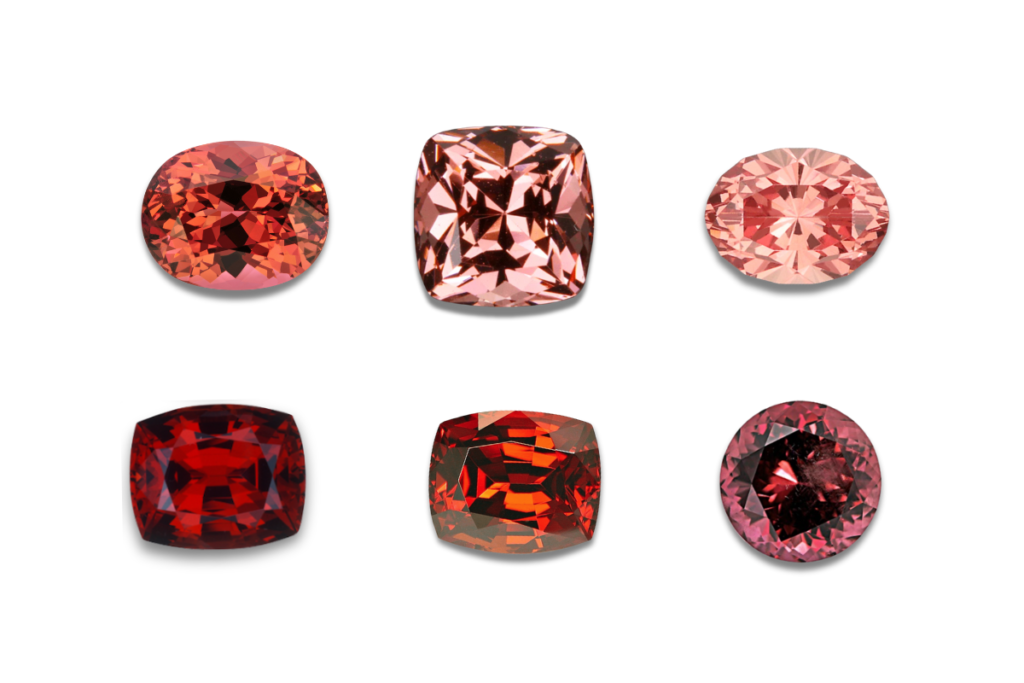
Malaya garnets have always lived in between. Their name comes from the Swahili word malaya, meaning “outcast” or “misfit”—a term once used by miners because these stones didn’t fit any known category. Too pink for spessartite. Too orange for rhodolite. Too warm to be ignored, too complex to be named.
Found primarily in Tanzania and Kenya, malaya garnets occupy a chemical middle ground between pyrope, spessartite, and almandine. This mixed identity is precisely what gives them their character. Their colors move through peach, rose, copper, soft cinnamon, sometimes shifting subtly under different light sources. Many show a gentle color change, not dramatic, but intimate—like skin responding to warmth.
Their real value lies in this individuality. Malaya garnets cannot be standardized, and for that reason they remain underappreciated by mass markets. Yet among gem cutters and jewelers who work by eye rather than label, the finest malaya stones are deeply respected. When well cut, they offer balance—saturation without heaviness, warmth without excess, presence without dominance.
Clarity is usually good, but what matters most is internal harmony. A fine malaya garnet glows rather than flashes. It feels alive without insisting on attention.
I’m drawn to malaya garnets because they resist certainty. They don’t settle into fixed identities. They remind me that value doesn’t always come from clarity of definition, but from the ability to respond—to light, to time, to change.
For January, when we’re asked to define ourselves too early in the year, malaya feels like permission to remain open.
The common thread
Across all cultures and varieties, garnet shares one meaning: protection through continuity.
Not protection that shields you from life—but protection that allows you to move through it intact.
Whether red, green, or orange, garnet has always been a stone for those in motion. For those who endure. For those who pass through darkness carrying their own light. Like the ones born in January.
A Jeweller’s note on buying garnet
I won’t turn this into a checklist. Garnet has never responded well to rules.
It responds to attention.
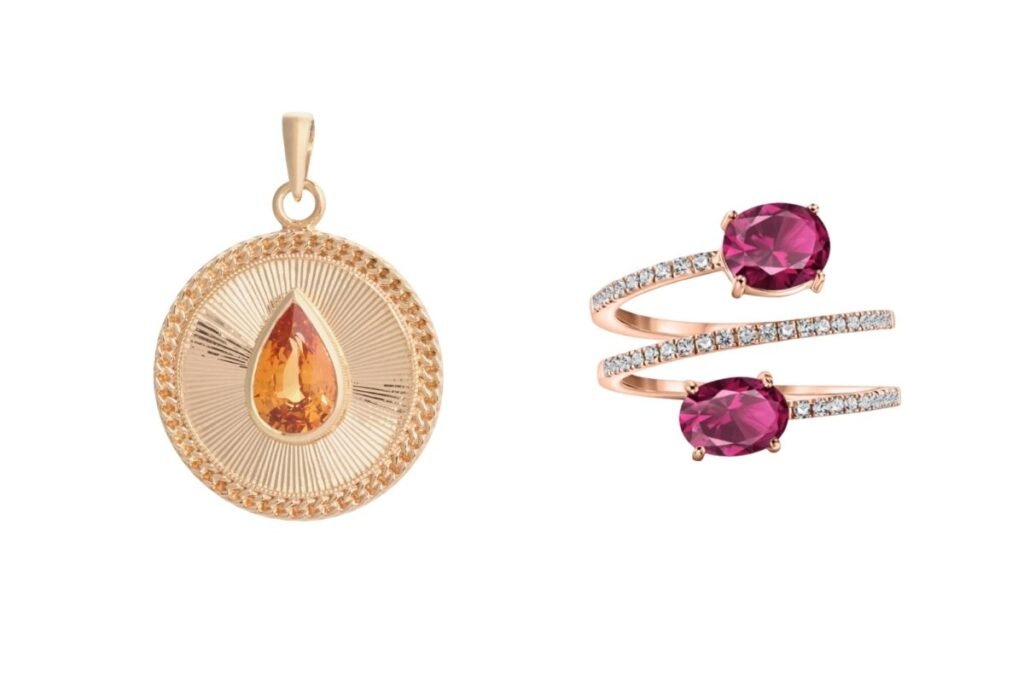
When choosing a garnet—especially as a January birthstone—I always begin with presence, not carat weight. Garnets carry density differently than many gems. A one-carat stone can feel monumental; a three-carat one can feel empty. This depends on cut, on color saturation, on how light settles inside the stone. You don’t measure garnet by numbers. You measure it by how it holds itself.
Color is the true language here. Not just red, but which red. Or green. Or orange. Look for depth without heaviness, intensity without harshness. A good garnet feels full—like a glass filled to the rim. If it looks watery, flat, or overly dark, it will never grow on you. Garnet doesn’t improve with time if the color isn’t right from the start.
Clarity is usually generous across the garnet family, but perfection isn’t the goal. Some inclusions—especially in demantoid—are part of the gem’s identity. Horsetail inclusions in Russian demantoid aren’t flaws; they’re signatures. What matters is whether the inclusions interrupt the stone’s life or quietly belong to it.
Cut deserves patience. Garnet shows its best self when cut to respect its body. Too shallow and it looks hollow. Too deep and it loses light. Well-cut garnets don’t shout; they breathe.
Origin matters more than most people expect. It shapes hue, tone, and energy. Tanzanian garnets carry different warmth than Mozambican ones. Namibian spessartites glow differently than Nigerian material. Learning these nuances is part of the pleasure. Birthstones, especially, deserve this intimacy. They’re meant to mark a life—not a trend.
And yes, certificates matter. But they come last. A garnet should speak to you before a document ever does.
Closing reflection with a personal note
January doesn’t ask us to bloom, but to glow from within with power.
It asks us to remain steady and keep the fire on while everything else sleeps.
Garnet has always belonged to those who moved through the world rather than watched it from afar. Warriors carried it into battle, believing it protected the body and hastened recovery from wounds. Travelers wore it sewn into clothing or rings, trusting it would guard them across unknown lands. Explorers kept it close as a stone of return—homeward fire.
It was set into sword hilts and armor, not for ornament, but for survival. Later, it found its way into royal treasuries and ceremonial jewels—deep red garnets glowing in medieval crowns, Renaissance signet rings, Victorian parures worn by queens and empresses. Not loud, not fragile. Enduring.
That lineage matters to me. Garnet isn’t a fashionable beginning—it’s a grounded one. And it feels right to open this journey through birthstones with a gem that carries so much history of movement, courage, and continuity.
This January is also personal. My nephew Gloria was born in the second week of this year—into winter, into beginnings that are quiet but profound. Garnet will be her stone. Not as a symbol of decoration, but as a reminder of strength carried calmly, of warmth held from within with deep love. A good omen for both of us!
I hope in future, I will be able to choose her specific garnet: grounded almandine, happy spessartine, powerful pyrope, sweet and deep rhodolite, playful demantoid, intense tsavorite, curious malaya garnet. Only her personality will tell me with time, and her auntie will be there waiting with the right stone on a open hand.