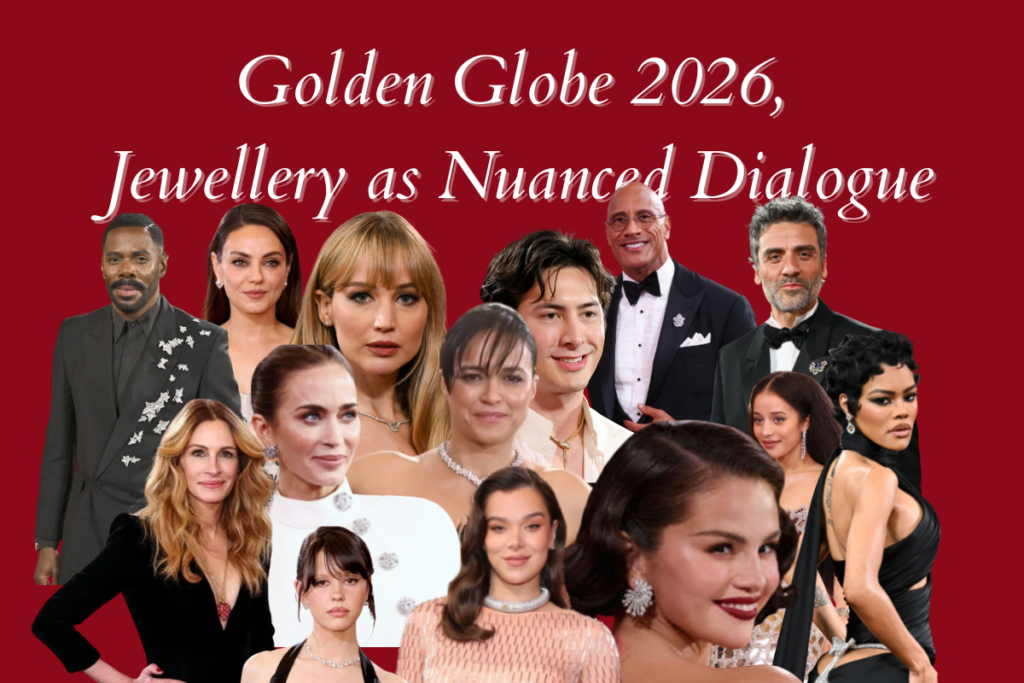
Golden Globe 2026, Jewellery as Nuanced Dialogue
When restraint, memory, and discretion shaped the red carpet
I’ve always found red carpets revealing, not because of their excess, but because of their limits. The Golden Globe Awards, which open the awards season each year, tend to expose these limits earlier than most. Less formal than the Academy Awards, they often reflect the cultural mood with fewer layers of polish.
In 2026, that mood was notably restrained. There was very little sense of opulence or overt display in the jewellery worn. No visual competition between pieces, no attempt to dominate the look through scale or accumulation. Instead, jewellery appeared consistently measured, often reduced to essential lines and familiar forms. From the first arrivals, it was clear that jewellery was not intended to be the focal point of the red carpet conversation.
As fashion moved toward stronger silhouettes, heavier textures, and more expressive construction, jewellery adjusted its role. Necklaces stayed close to the body, earrings were light and controlled, rings were worn singly rather than stacked. Even when high-value pieces appeared, they were styled with discipline rather than spectacle. The result was a clear hierarchy: fashion led, and jewellery supported.
This was not absence, but positioning. Jewellery did not withdraw; it responded. It softened its presence to balance what was being worn, adding clarity rather than visual noise. In doing so, it revealed a broader shift—one in which jewellery is no longer expected to carry the weight of the look, but to reinforce it quietly, allowing proportion, restraint, and coherence to take precedence over ostentation.
Restraint as a Shared Language
Across the red carpet, very different celebrities seemed to speak the same visual language. Jewellery did not dominate. It accompanied.
Fine diamond lines appeared repeatedly—necklaces that sat close to the skin, earrings that followed the ear rather than framing the face, rings worn singly. There was a clear absence of stacking, layering, or visual accumulation. Pieces were chosen to exist within the look, not above it.
Kylie Jenner was among the few who embraced scale, wearing high-carat diamonds by Lorraine Schwartz. Yet even here, the effect was controlled. The stones did not fight the outfit. They settled into it. Diamonds of this size carry their own gravity. When worn without irony or excess styling, they quiet everything else around them.
Elsewhere, restraint took precedence.
Amanda Seyfried’s choice of archival diamonds from Tiffany & Co.’s Blue Book lineage reinforced a different kind of confidence. Clean geometry, balanced light, minimal movement. Jewellery that does not seek relevance because it already has it.
Elle Fanning in Cartier reflected the same discipline. The necklace framed rather than decorated, holding its position with architectural clarity. Cartier has always understood this: jewellery does not need to move to be felt.
Bulgari, Present Without Exaggeration
One of the most consistent yet understated presences of the evening was Bulgari.
Priyanka Chopra Jonas wore Bulgari with remarkable restraint. The jewellery did not announce itself. It followed the lines of her look, offering texture and depth without asserting dominance. This was Bulgari at its most mature—sensual, but contained. Expressive, but aware.
The same sensibility appeared in other Bulgari moments throughout the night, including sculptural gold worn close to the neck, never excessive, never ornamental for ornament’s sake. This repeated presence mattered. It reinforced the idea that jewellery does not need to perform loudly to be recognised.
The presence of Bulgari also extended into more unconventional territory, particularly through a man wearing Serpenti — Hudson Williams — a choice that felt deliberate rather than provocative. On a man, Serpenti becomes less about ornament and more about self-definition. It reads as a statement, yes, but an elegant one: jewellery used to express personality and confidence, not opulence. Stripped of theatricality, the serpent’s symbolism — strength, continuity, transformation — feels almost understated, carried with ease rather than displayed.
A similar departure from expectation appeared in the Vimini choker worn by Lalisa Manobal. Unlike Bulgari’s more recognisable colour-driven high jewellery, the Vimini necklace relies on form, texture, and structure rather than gemstones. Crafted in sculptural gold, it creates an iconic presence without relying on colour at all — a rare move for a maison so closely associated with vibrant stones. The result is a piece that feels architectural and timeless, reinforcing the idea that identity, not excess, is what now defines impact on the red carpet.
The Return of Familiar Lines
One of the clearest signals of the evening was the return of familiar jewellery forms—shapes and gestures that felt recognised rather than revived. This was not a literal looking back, nor an exercise in nostalgia, but a sense of continuity, as if certain lines had simply waited for the right moment to reappear.
Slim diamond necklaces rested close to the skin, light earrings followed the ear without framing it, and pearls were worn as something lived in rather than ceremonial.
In this context, pearls by Mikimoto felt especially aligned with the mood: quiet, luminous, present without performance. Pearls have always found their place in periods of restraint; they respond to light gently, never insisting on attention, never overwhelming the wearer.
A similar emotional discipline could be felt in the work of Pasquale Bruni, where feminine lines and soft curves conveyed intimacy rather than display—jewellery designed to be felt before it is noticed. Even the presence of Brilliant Earth carried a quiet significance. Ethical sourcing paired with visual discretion reflects a broader cultural shift: values are increasingly communicated through choice rather than declaration, through what is absent as much as what is shown.
Within this same language, brooches made a measured return, particularly on figures like Colman Domingo, not as decorative flourishes but as markers of confidence. Worn without irony or exaggeration, the brooch reclaimed its place as a sign of presence and assurance—an ornament that does not seek attention, yet never feels apologetic for existing.
Colour, Carefully Contained
Colour was present throughout the evening, but it never felt dispersed or decorative. It appeared selectively, almost cautiously, as if aware of the visual weight it carries. Rather than functioning as an immediate focal point, colour worked as a measured interruption within otherwise disciplined compositions.
Hailee Steinfeld’s yellow diamond by Repossi illustrated this approach with clarity. The stone did not soften the look or add flourish; instead, it introduced a subtle tension, sharpening the overall impression through contrast. Its impact came from control rather than intensity. This way of using colour—sparingly, deliberately, and without excess—suggests a broader direction for 2026, one that values precision over abundance.
Colour is no longer there to decorate or to impress at first glance, but to shift balance slightly, to hold the eye for a moment, and then let the composition settle again.
Watches, Time, and Authority
Watches moved through the evening quietly, but with a presence that felt deliberate rather than incidental. Jennifer Lawrence’s choice of a 1920s-inspired watch carried a particular resonance, bridging cinema history and jewellery history without needing explanation. Early wristwatches were never conceived as accessories; they were instruments, worn close to the body, marking time as something practical and personal. Seeing this reference on the Golden Globes carpet felt intentional.
Time was worn, not displayed, allowed to exist within the look rather than define it. Other women followed this same instinct, choosing discreet watches on leather straps, often barely visible beneath sleeves. These were not styled gestures designed to be noticed, but private decisions—objects worn for their meaning rather than their image. In this way, time entered the conversation naturally, without interruption or emphasis. Men’s jewellery echoed this same restraint.
Dwayne Johnson’s choice of Chopard reflected polish and precision rather than spectacle, with watchmaking and jewellery aligning seamlessly with his presence instead of competing with it. At the other end of the spectrum, Benny Blanco paired diamonds with a watch by Jacob & Co., embracing scale while maintaining control. The effect was assertive, but not chaotic—proof that even when jewellery grows bolder, intention remains the defining factor.
Jewellery, After the Applause
The absence of ostentation at the Golden Globes this year is difficult to overlook, and it feels connected to a broader cultural undercurrent rather than a simple aesthetic choice. Historically, periods marked by political instability, economic uncertainty, and social tension tend to produce quieter forms of luxury, and jewellery often responds first.
This is not a retreat driven by fear, but a form of awareness. Large gemstones and overt displays read as celebration, even triumph, and the current moment calls for a different tone—one of containment and consideration. Jewellery has adjusted accordingly, not by withdrawing, but by recalibrating. Desire has not disappeared; it has shifted register.
The Golden Globes 2026 did not introduce new trends so much as clarify an ongoing transition: jewellery is no longer expected to lead the visual narrative, but to participate in it. It responds to fashion, to context, and to mood.
The return of older lines—brooches, slim diamond necklaces, pearls worn close to the body—reflects a renewed respect for proportion and continuity.
Diamonds remain central, but they are worn with discipline rather than display. This is not a year defined by excess. It is a year defined by dialogue.
Jewellery does not need to raise its voice; it simply needs to know when, and how, to speak.