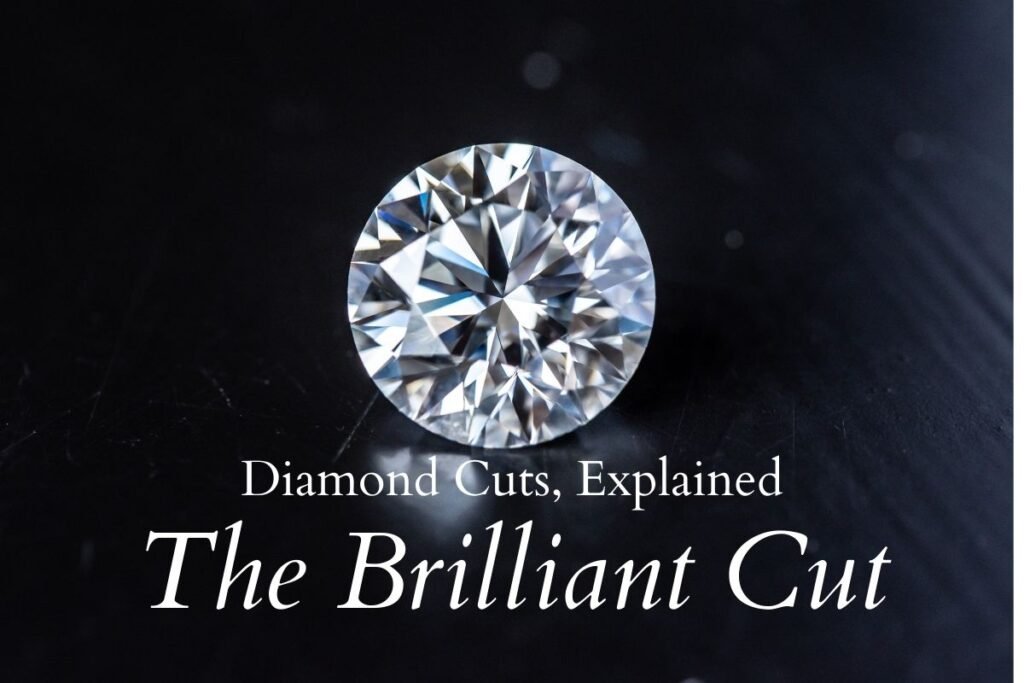
Diamond Cuts, Explained — The Round Brilliant
Why cut is the first decision that matters.
The brilliant cut is the most classic contemporary diamond cut.
It is engineered for light. Every facet and proportion is calculated to control how light enters the stone, reflects internally, and returns to the eye. It represents one of the most precise applications of modern engineering to gem cutting, where optical performance is the primary goal.
The round brilliant is also the most reliable reference for evaluating a diamond.
While every diamond has its own optical character, this cut makes performance measurable. It allows light behavior to be assessed objectively rather than intuitively.
This is why cut must always be the first criterion when evaluating a diamond—before carat, color, or clarity.
A diamond’s ability to appear bright, lively, and balanced does not come from its weight or its absence of inclusions. It comes from proportion. If the geometry is incorrect, light leaks through the pavilion or escapes through the sides. No level of color or clarity can correct that failure.
Diamonds do not sparkle simply because they are diamonds.
They sparkle because their proportions allow light to enter, reflect, and return efficiently.
In practice, cut determines whether a diamond functions as an optical system or remains only a polished crystal. This is especially true for the round brilliant, which is the most studied, measured, and refined diamond cut in history. Its performance depends entirely on precise, interdependent proportions—depth, table, crown, and pavilion working as a single structure.
Carat, color, and clarity describe what a diamond is.
Cut determines whether it works.
This is where evaluation becomes technical.
And this is where it should begin.
The modern round brilliant: why proportions matter more than anything else
The round brilliant cut as we know it is not ancient. It is the result of decades of optical research, especially in the 20th century, when gemologists began to measure how light behaves inside diamond rather than how diamond simply looks from the outside.
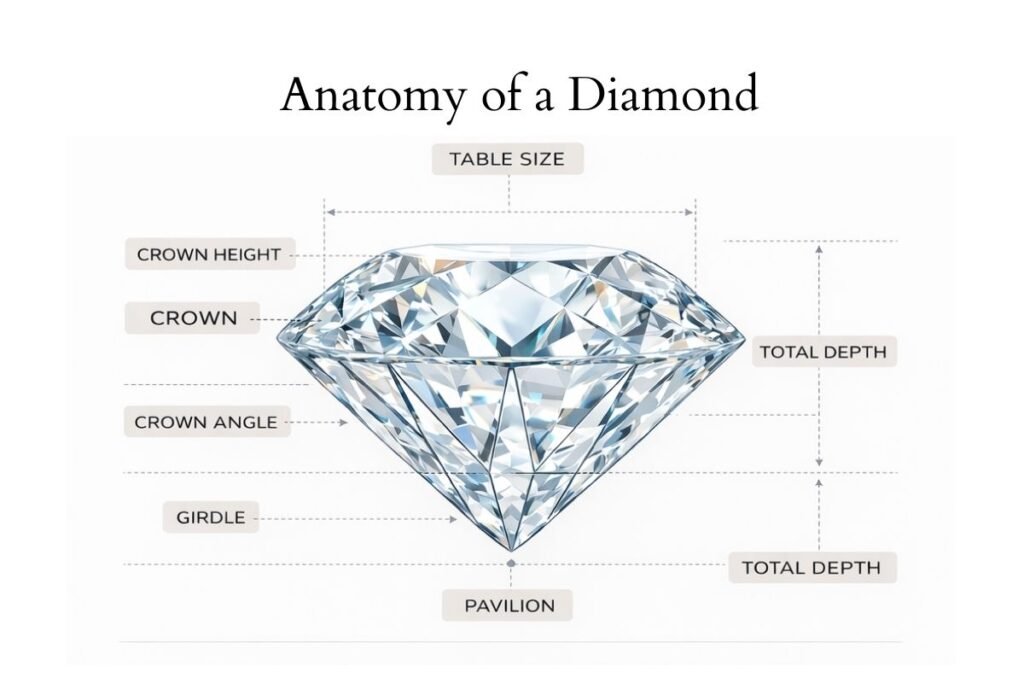
A modern round brilliant has 57 or 58 facets. That number alone tells you nothing. What matters is how those facets relate to each other.
The goal is simple: light enters through the table, reflects internally, and returns to the eye rather than escaping through the bottom or sides. Every proportion is designed to support that journey.
At the center of this system is total depth.
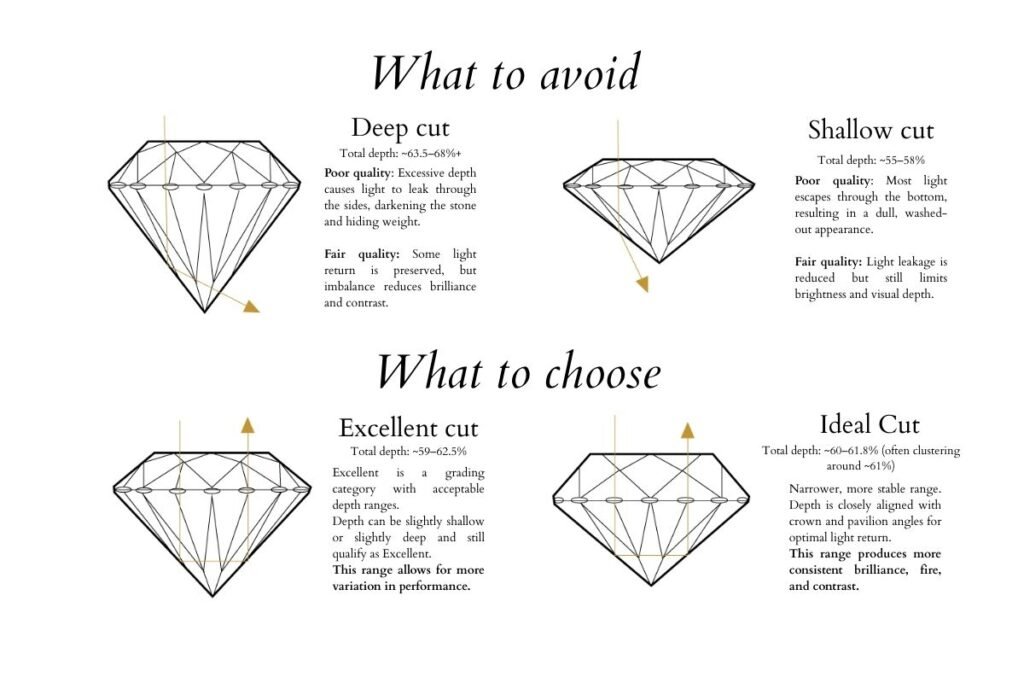
For a round brilliant to perform at its best, total depth should sit around 61% of the stone’s diameter. This is not an arbitrary number. It is the balance point where light reflection and dispersion are optimized.
Too shallow—below roughly 59%—and light leaks through the pavilion. The stone looks glassy, watery, sometimes bright but empty.
Too deep—above 63%—and light gets trapped or escapes sideways. The diamond darkens in the center. Weight is hidden where it cannot be seen.
That 61% is not a guarantee of beauty, but it is a gatekeeper. Without it, brilliance struggles.
Crown, pavilion, and table: the internal architecture of sparkle
What matters is never a single percentage considered in isolation. In a round brilliant, proportions function as an interdependent optical system. Table size, crown angle, pavilion angle, and total depth are not absolute values but variables that must work together. When one parameter shifts, others must compensate to preserve efficient light return.
Within well-performing modern round brilliants, there are stable proportional ranges where optical performance is most reliable. For example, a table between 54–57%, combined with a crown angle around 34–34.5° and a pavilion angle close to 40.6–40.8°, consistently produces strong brightness, balanced contrast, and controlled dispersion. These combinations minimize light leakage while maintaining fire and visual depth.
When the table increases toward 58–60%, crown height is reduced and dispersion decreases. In this configuration, performance can still be preserved, but only if the crown angle remains slightly steeper within tolerance and the pavilion angle stays tightly controlled. Without this compensation, the diamond may appear bright but optically shallow.
Conversely, smaller tables around 54–55% increase crown height and dispersion. These combinations perform best when the crown angle is moderate and the pavilion remains near the lower end of its optimal range. If both crown and pavilion angles become too steep, internal reflections are disrupted and light loss increases, often resulting in a darker central area. If both are too shallow, light escapes through the pavilion, producing a glassy appearance.
Total depth is therefore not a target in itself, but the outcome of these internal relationships. A depth near 61% often reflects a well-balanced configuration, yet diamonds slightly outside this range can still perform at a high level if crown and pavilion angles compensate correctly. This explains why stones with similar depth percentages—and even similar laboratory grades—can behave very differently in real light.
For this reason, there is no single “perfect” set of numbers. The round brilliant does not follow a rigid formula. It follows optical balance. Performance depends on how proportions interact, not on isolated values listed on a certificate.
This complexity is also why professional evaluation matters. Interpreting how these variables work together requires more than reading a grading report. An experienced advisor assesses the full geometry of the stone and its optical behavior, ensuring that proportions function as a coherent system rather than a collection of acceptable ranges.
What to actually look for when buying a round brilliant
This complexity is why professional evaluation matters when selecting a round brilliant. Interpreting how proportions work together requires more than reading a grading report. Laboratory certificates list measurements, but they do not assess how those measurements interact optically. An experienced advisor evaluates the full geometry of the stone and observes its behavior in real light, ensuring that proportions function as a coherent system rather than as a collection of acceptable ranges.
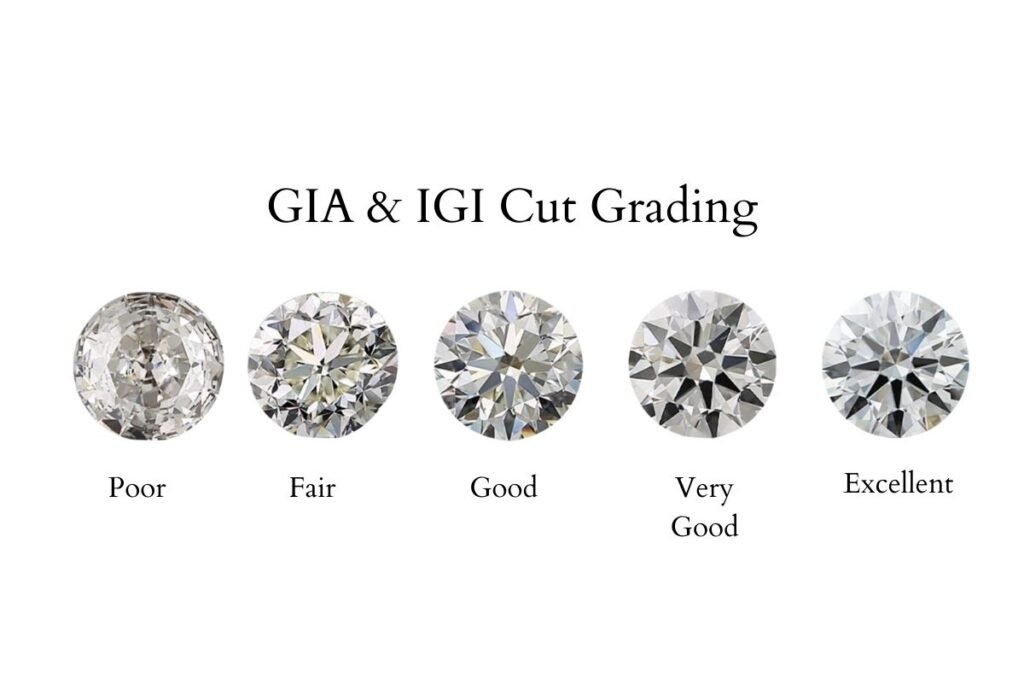
For consumers, a practical starting point is understanding cut grading itself. Major laboratories such as GIA and IGI classify round brilliant cuts on a scale that typically ranges from Poor, Fair, Good, Very Good, to Excellent. These categories reflect increasing levels of proportional accuracy, symmetry, and finish. Stones graded Poor or Fair usually suffer from significant light leakage and should be avoided. Good cuts represent a functional but compromised balance, often prioritizing weight retention over optical performance. Very Good cuts can perform well, but they still allow a broader margin of variation in proportion and light behavior.
At the top of this scale sits Excellent, which indicates the highest level of manufacturing precision within laboratory standards. When combined with Excellent symmetry and Excellent polish—commonly referred to as 3EX—this grade eliminates most structural faults and establishes a solid baseline for performance. A comparable reference in IGI grading is an Excellent cut with Excellent finish, which follows similar proportional tolerances.
However, “Excellent” does not mean uniform performance. Within this category, optical results can vary considerably. Two diamonds can share the same 3EX or IGI Excellent classification and still differ in brightness, contrast, and fire. This is because laboratory cut grades assess acceptable ranges for individual parameters, not the quality of their interaction.
This is where the distinction between Excellent and Ideal becomes relevant. “Ideal cut” is not a laboratory grade, but a descriptive term used to identify diamonds whose proportions work together with exceptional balance. These stones sit in the most stable zone of interacting ranges, where crown, pavilion, table, and depth reinforce one another rather than simply complying with minimum thresholds. Not every Excellent-cut diamond reaches this level, and identifying those that do requires evaluation beyond numerical filters.
For this reason, the role of the dealer is critical. A knowledgeable and ethically driven professional does not select diamonds based on cut grade alone. They assess optical performance. They understand which proportional combinations consistently produce strong light return and which ones, while technically acceptable on paper, fail in real conditions. The difference lies not in the certificate itself, but in the expertise applied to its interpretation.
Cut quality determines how a diamond performs.
Expert evaluation determines whether that performance is fully realized.
Why “ideal” is not universal—but informed selection is
There is no single perfect diamond.
There is only coherence between proportion, performance, and intent.
Whether a diamond is natural or lab-grown, the laws of optics are the same. Light responds to geometry, not origin. What changes is how well that geometry is understood and selected.
Certificates provide measurements, not judgment. They do not tell you how a diamond will perform in real light or whether it represents true value. That assessment requires experience.
This is where our work begins.
We evaluate diamonds beyond grades, analyzing how proportions interact and how light behaves in practice. We select stones that function as complete optical systems, not just those that meet acceptable ranges.
The result is a diamond that performs consistently and confidently—without relying on excess sparkle or explanation.
Informed selection is not about chasing numbers.
It is about knowing exactly what you are buying—and why it is worth it.
Write to us for your next stone, and we will provide you the most sparkling diamond of all.