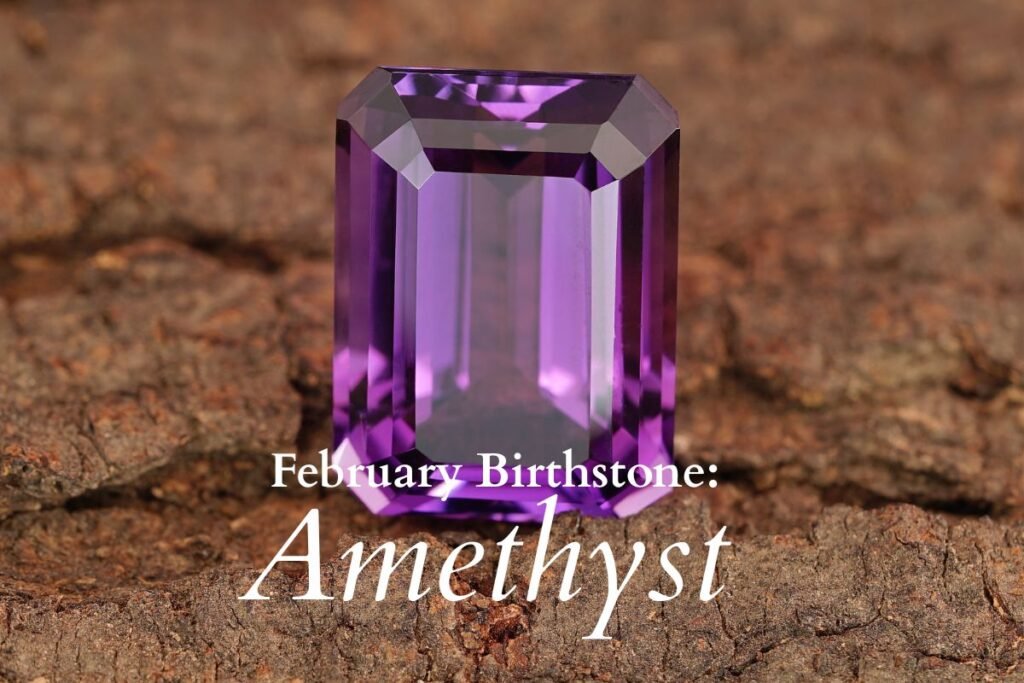
February Birthstone: Amethyst.
A gemstone ones reserved only to kings and queens.
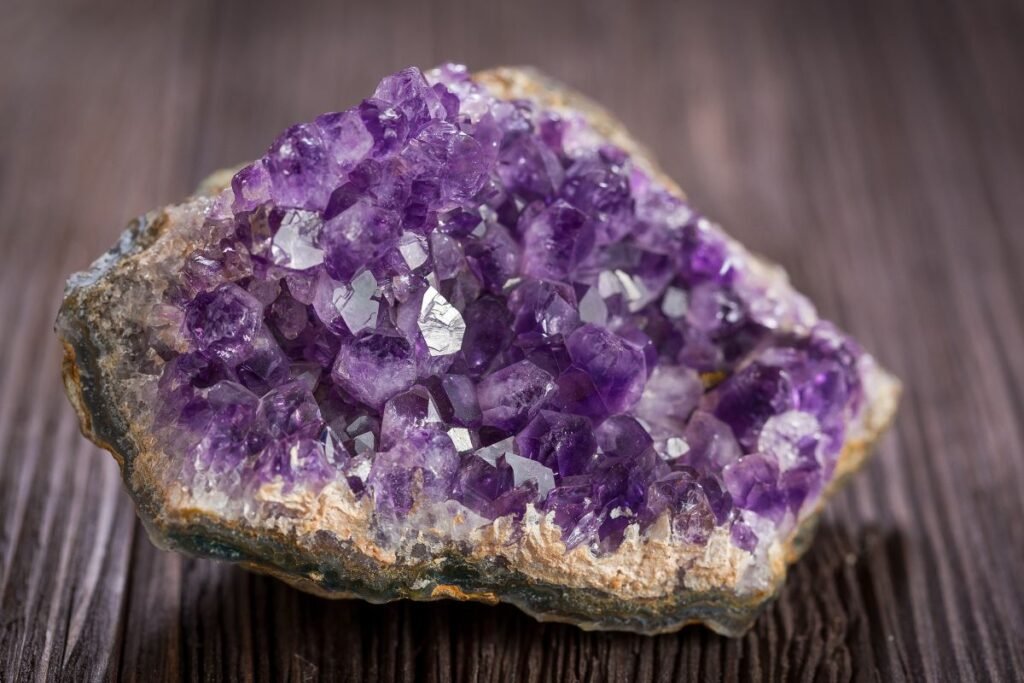
I first knew amethyst as a geode, not as a gemstone.
My parents had large amethyst geodes around the house. Heavy pieces, split open, dense with crystals. They weren’t decorative objects and they weren’t jewellery. They were there because they showed, very clearly, what nature can do on its own. Structure, repetition, colour—formed without intervention. That’s what stayed with me.
For a long time, that was amethyst to me. Not something to wear. Something to observe.
Only later did I start thinking about amethyst as a gem. Cut, polished, set into jewellery. And even then, I approached it with hesitation. Amethyst is everywhere. It’s used often, especially in demi-fine jewellery, and because of that it’s rarely taken seriously. Familiarity flattened it.
But the stone itself never changed.
Amethyst is one of the oldest recorded gemstones in continuous use. It was named, traded, and symbolised long before modern ideas of rarity existed. Its value was not built on scarcity alone, but on meaning, discipline, and colour that held without needing brilliance.
The problem isn’t amethyst. It’s how casually it’s used.
When the colour is right, when the cut is controlled, amethyst has presence. It doesn’t need scale or excess to work. It carries weight visually and historically.
That’s why I still use it. And why I think it deserves a reset—not as an entry-level stone, not as filler, but as a material with real authority when treated properly.
Before rarity was measured
Amethyst appears in the earliest written accounts of gemstones in the Mediterranean world. The Greeks named it amethystos—“not intoxicated.” The belief was simple and literal. Drink from an amethyst vessel and wine would lose its power over you. Whether this was chemistry or conviction hardly mattered. What mattered was the association: clarity of mind, control, moderation.
The Romans inherited the belief and refined it. Senators wore amethyst rings not as ornament, but as signal. The stone suggested composure. Judgement. A distance from excess.
In Europe, amethyst was reserved for the highest levels of society. It was owned and worn by royalty and by senior figures within the Church, and it was grouped with diamond, ruby, and sapphire as one of the stones of power. This was not symbolic excess but practical reality: deeply coloured amethyst was scarce, difficult to source, and expensive. Its use was limited by access, not taste, and its presence marked rank and authority in the same way other precious stones did at the time.
What’s often forgotten is that, until the late nineteenth century, amethyst belonged in the same category as ruby, sapphire, and emerald. It was classified as a precious stone. Its price reflected that status. Large, saturated crystals were rare enough to justify it.
Then geology intervened.
When the earth changes the market
In the second half of the nineteenth century, major amethyst deposits were discovered in Brazil, followed later by Uruguay. The scale was unprecedented. Entire geodes—cathedral-sized cavities lined with purple quartz—entered the market.
Availability changed. Perception followed.
This is where many simplified narratives stop. Amethyst became “common.” Its value dropped. End of story.
But that’s not how gemstones work. Supply affects price, yes. It does not erase hierarchy.
What changed was not amethyst’s nature, but our selectivity.
Before these discoveries, almost any fine amethyst was rare. After them, only the best remained so.
This forced a distinction that still matters today.

Colour is not a single word
When people say “amethyst,” they often imagine one colour. Purple. That’s insufficient.
Amethyst spans a wide chromatic range. Pale lilac. Greyed violet. Reddish purple. Blue-leaning violet. The stone’s value lives entirely inside this spectrum.
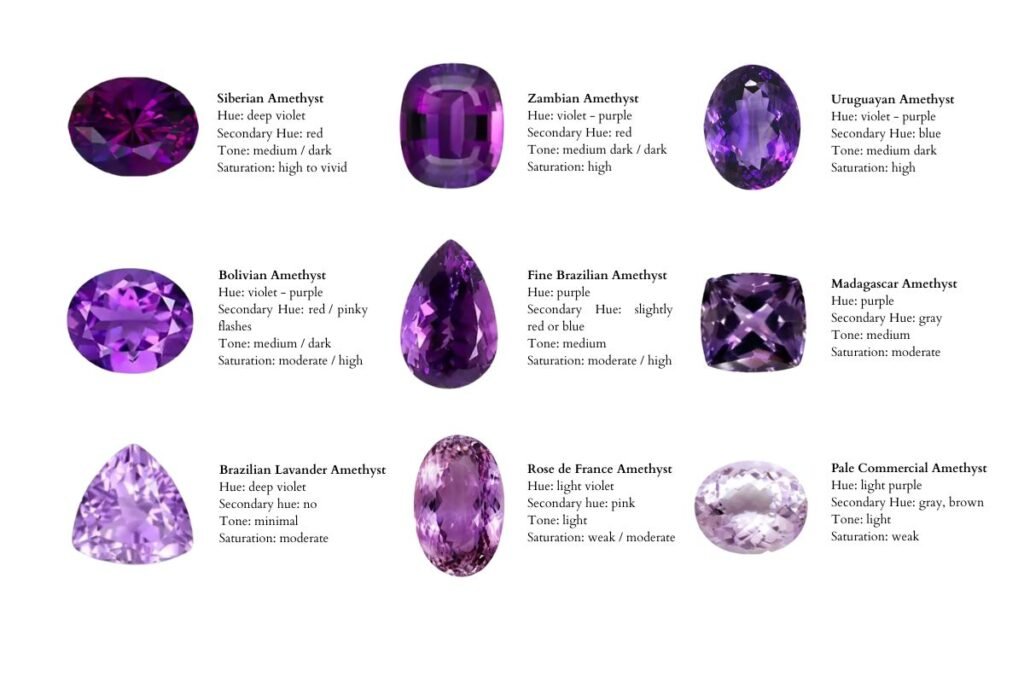
There is no official, standardized colour grading system for amethyst. In practice, colour is described using the same gemological framework applied to most coloured stones: hue, tone, and saturation. Amethyst’s primary hue is purple or violet, often modified by secondary red or blue tones. The most valued stones show strong saturation with a medium to medium-dark tone and no brown or grey modifiers. Trade terms such as Siberian or Russian describe a colour reference—deep purple with a red secondary hue—rather than a guaranteed origin. Lighter material, including Rose de France, falls at the pale end of the spectrum and is valued for transparency and size rather than depth. Ultimately, amethyst colour is assessed face-up, by balance and density, not by naming conventions.
The most prized hues are saturated but controlled. A deep violet with a secondary red flash, visible when the stone moves. Not blackened. Not brown. Not washed.
Stones from Siberia—historically, not commercially today—set the benchmark. Rich purple with red undertones, high saturation, excellent transparency. When dealers still refer to “Siberian colour,” they’re invoking this memory, not a current origin.
Uruguayan amethyst often comes close. Its crystals tend to show strong saturation and cooler tones, sometimes with blue flashes. Brazilian material varies more widely, from pale commercial grades to fine saturated stones.
African sources—Zambia, Madagascar—produce smaller quantities, often with darker tones and good clarity.
Then there is “Rose de France.” A name that confuses many buyers. It refers to pale lavender amethyst, soft in tone, often larger in size. It has its place. It should not be mistaken for top saturation.
Colour zoning is common. Uneven colour distribution can reduce value unless the cutter has worked intelligently around it. This is one of the first things I look for under the loupe.
Sourcing, the true need
Sourcing amethyst is not something that happens often, and that is precisely why it deserves attention. The market is saturated with commercial-grade material, which creates the illusion that good amethyst is easy to find. It isn’t. Stones with real colour density, clean structure, and visual balance are a small fraction of what is available, especially once you move into higher carat weights. Large amethyst exists in abundance; large high-quality amethyst does not. At that scale, colour tends to flatten, darken, or lose control. This is where sourcing becomes critical. Working with a trusted hunter—someone who understands colour behaviour, cutting, and origin, not just price—makes the difference between a stone that fills space and one that holds presence.
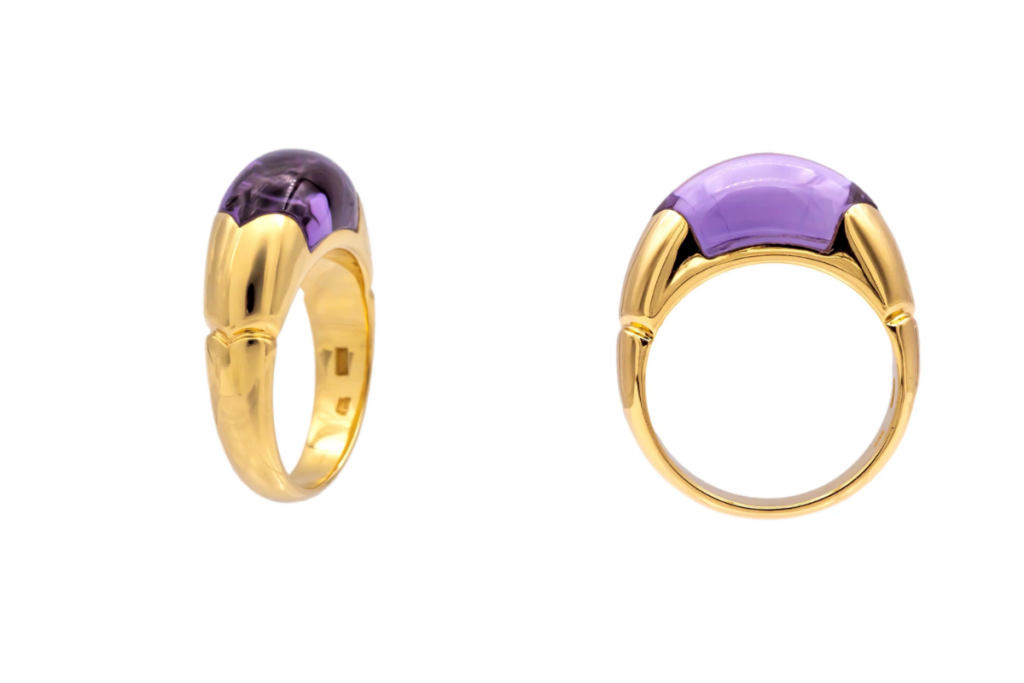
Amethyst is visually strong, stable, and historically loaded, which makes its absence from high jewellery noticeable. It has the scale to work in important pieces, the durability for long-term wear, and a colour that doesn’t rely on brilliance to assert itself. When chosen carefully, it holds its own next to far rarer stones without needing to compete. Used with intention, amethyst belongs in high jewellery not as an alternative, but as a deliberate choice.
What to look for, and what to ignore
Amethyst is a variety of quartz. Chemically, it is silicon dioxide, formed in hexagonal crystals, with its purple colour caused by trace amounts of iron and natural irradiation within the earth. It ranks 7 on the Mohs scale, which makes it durable enough for daily wear, but not indestructible. What matters more than the chemistry is how consistently quartz forms: clean crystal structure, high transparency, and colour that sits within the stone rather than on its surface. That internal order is what gives amethyst its calm, stable appearance when it’s cut well. When buying amethyst, clarity is usually high. Quartz forms cleanly. Eye-visible inclusions are a warning sign unless the stone is unusually large.
Cut plays a decisive role in the appearance of amethyst and is often underestimated. Inadequate proportions reduce colour intensity, while pavilion depth directly affects saturation and visual depth. Even high-quality rough will appear pale if the stone is cut too shallow.
Size can also be misleading: large amethyst is widely available, but large stones with controlled colour and optical balance are not. Quality assessment should remain grounded in observable characteristics—hue, tone, saturation, transparency, and overall balance—rather than symbolic or metaphysical claims.
When origin is stated, it should be supported by credible methodology. In quartz, origin is rarely certified, and any claim should be treated as descriptive rather than absolute.
Price, without romance
Amethyst prices span a wide range. Commercial material trades at low levels, while fine stones with controlled colour and good cutting command higher values. Even at the top of the category, amethyst does not behave like ruby or sapphire, and it never has. That is not a limitation of the stone, but a reflection of its availability.
A well-cut amethyst of a few carats with strong natural colour may be priced in the hundreds per carat, with exceptional examples exceeding that range. Pale or weakly saturated material sits far below. From an investment perspective, amethyst is not driven by scarcity and should not be approached as a financial asset.
It is chosen for different reasons. When used intentionally—especially in high jewellery—amethyst can anchor a piece with scale, colour, and historical weight, resulting in something singular. In most cases, amethyst is bought out of appreciation for the stone itself, not in expectation of future escalation.
An ancient stone, why it endures
Amethyst has moved through centuries without changing its nature. It has been sacred, reserved for power, later made accessible, then overlooked, and repeatedly rediscovered. That continuity is part of why it remains the February birthstone. It was chosen not casually, but because it was long associated with clarity, balance, and protection—qualities traditionally linked to Aquarius and Pisces, the signs that sit in this month. For centuries, amethyst was considered one of the most powerful and valued gemstones available, admired for its depth of colour and the sense of order it carried.
I work with amethyst because it responds well to intention. It doesn’t rely on brilliance or scale to function. It holds colour, it stays stable, and it integrates naturally into considered design. When used thoughtfully, it doesn’t dominate a piece, but it gives it structure.
In my work, amethyst is never filler. It is chosen when a design needs presence without excess and history without nostalgia. That balance is rare. And it is exactly why this stone has endured as long as it has.