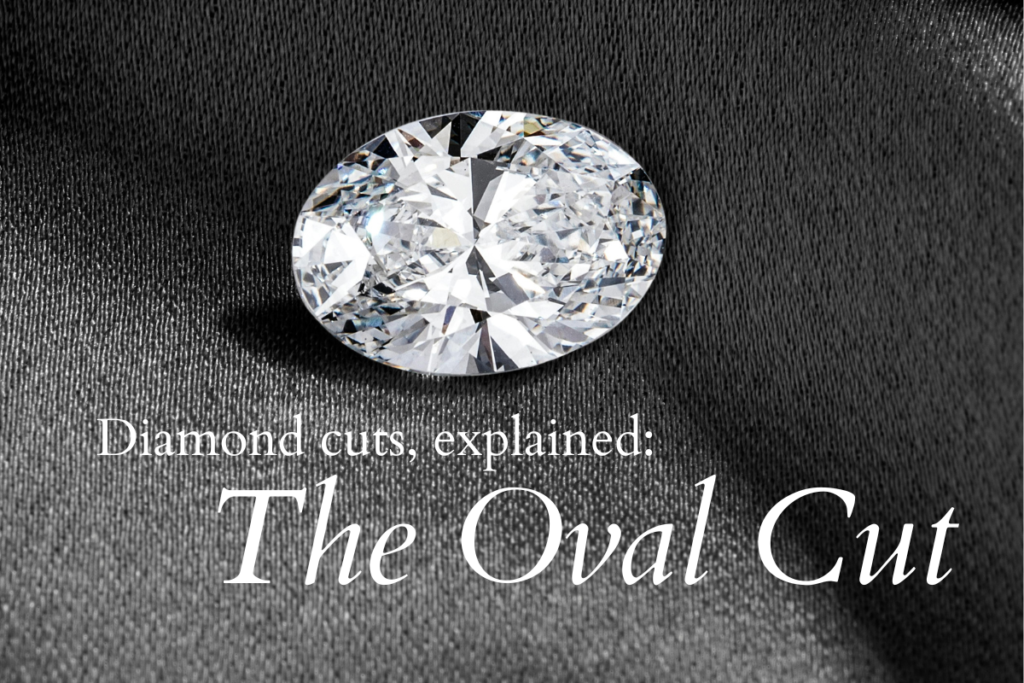
Diamond cut, Explained: The Oval
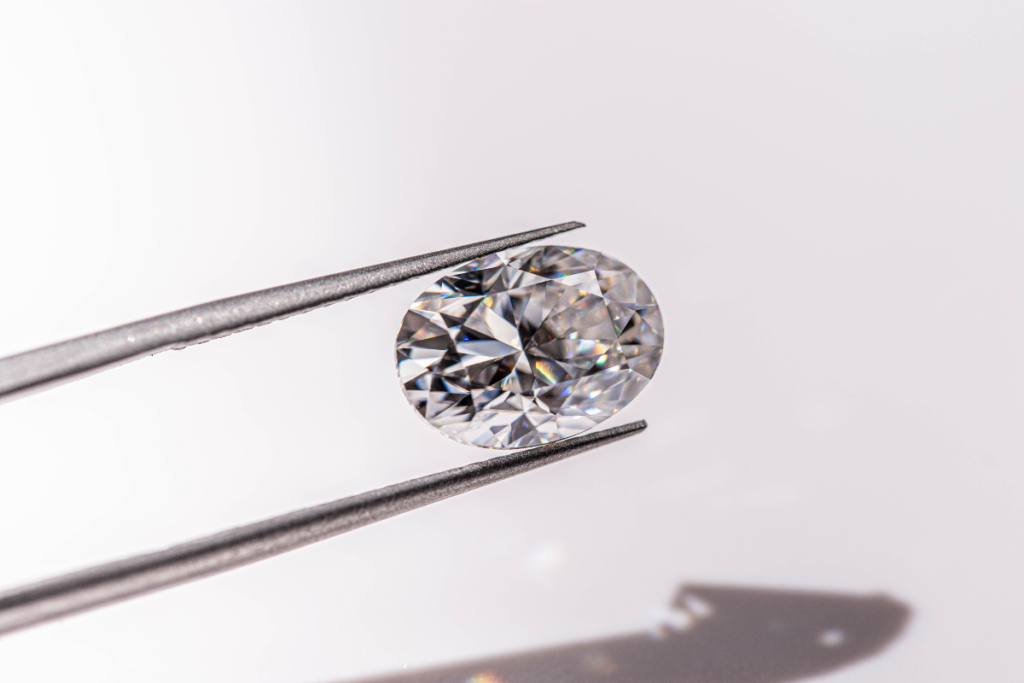
If you are considering an oval cut diamond, you are not alone. The oval is one of the most popular diamond shapes on the market today. It is often chosen because it looks larger than a round brilliant of the same carat weight. The elongated surface creates more visible spread. On the hand, it feels generous.
What most buyers don’t realize is that the oval cut is harder to buy correctly than a round diamond.
There is no universal cut grade for oval cut diamonds. Laboratories like GIA do not assign an overall cut score the way they do for round brilliants. That means two ovals with the same carat, color, and clarity can perform completely differently. One will look bright and balanced. The other may show a heavy bow-tie, dull center, or uneven ends.
This guide explains exactly what to look for when buying an oval cut diamond: ideal proportions, depth and table percentages, length-to-width ratio, bow-tie behavior, and how light actually moves inside the stone.
Oval Cut Diamond Shape: Length-to-Width Ratio and Outline Symmetry
Before checking depth or table percentages, look at the outline.
The outer contour of an oval cut diamond must be even. No egg shape. No one shoulder heavier than the other. No ends that come to a point or flatten unnaturally. Even if the lab report lists Excellent symmetry, that refers to facet symmetry — not the shape outline.
You must judge the perimeter with your eyes.
Ideal Length-to-Width Ratio for Oval Cut Diamonds
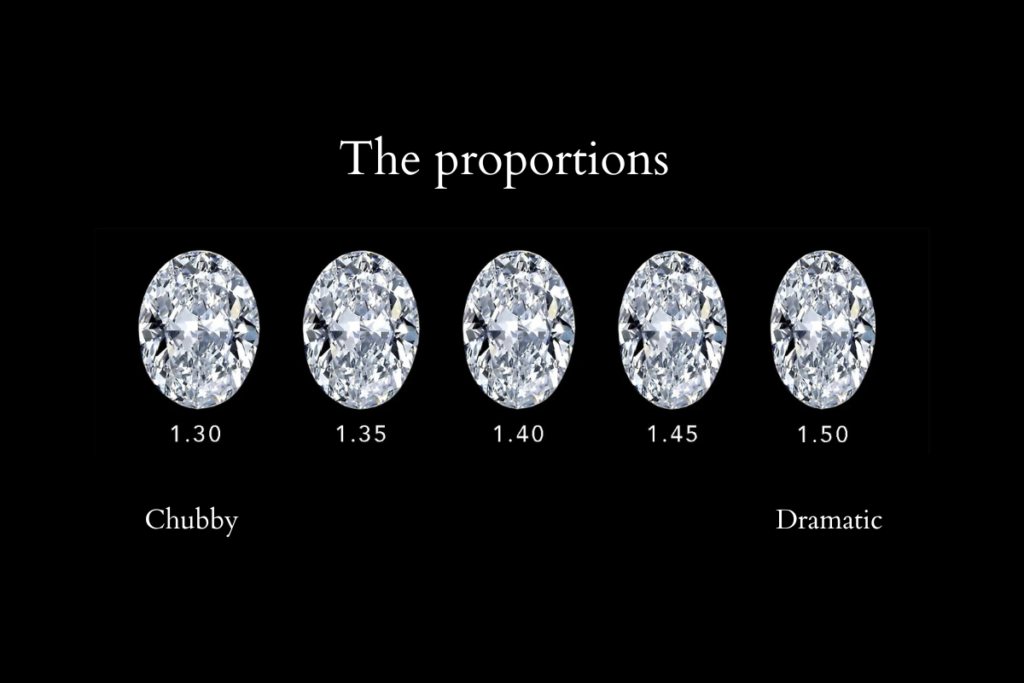
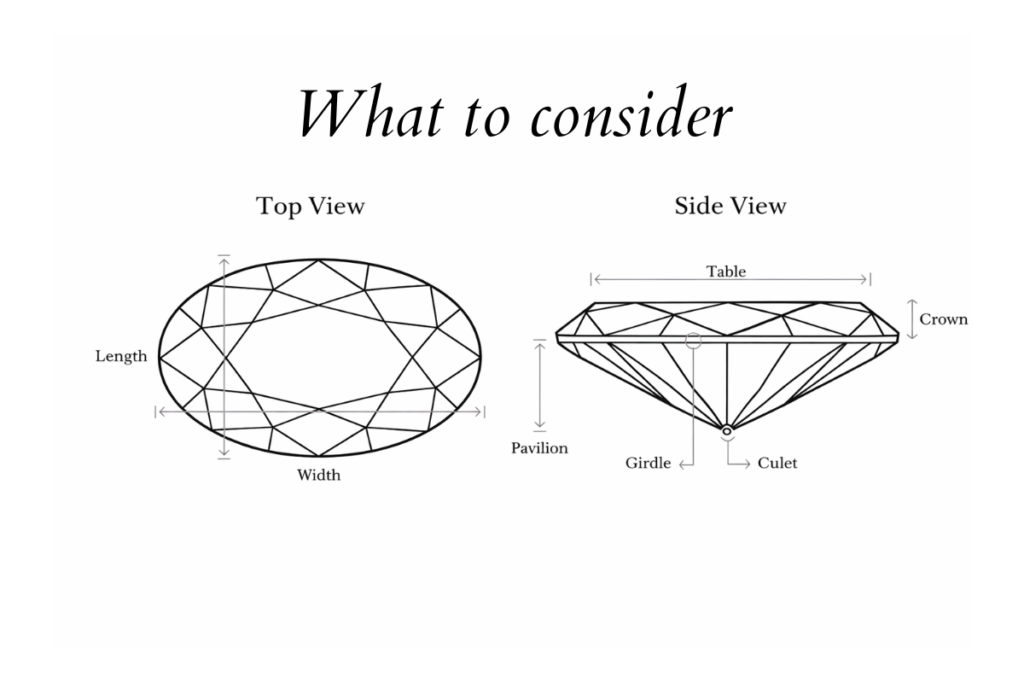
The length-to-width ratio (L/W) determines how elongated the oval appears.
- 1.30–1.35: Softer look, closer to a round brilliant
- 1.36–1.45: Balanced, classic oval appearance
- 1.46–1.50+: More elongated and dramatic
There is no single “best” ratio. However, the more elongated the oval, the more difficult it is to cut properly. Long ovals tend to show bow-ties more strongly and can exaggerate uneven light return if proportions are off.
If you prefer a very elongated oval, make sure the cut quality is strong enough to support it.
The Bow-Tie Effect in Oval Cut Diamonds
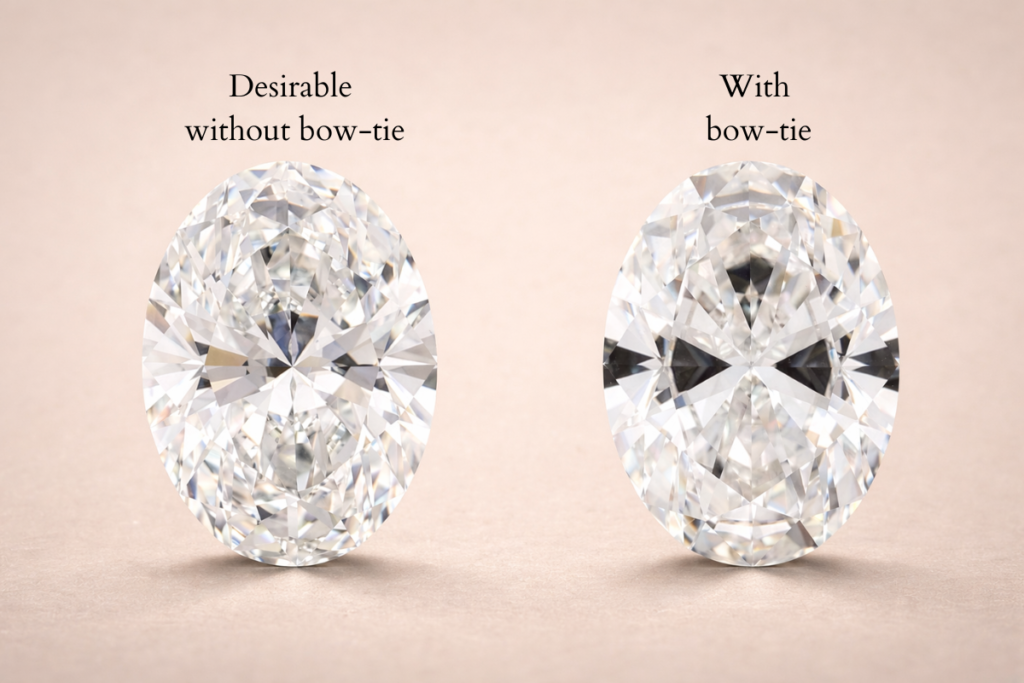
The bow-tie effect is the dark shape that appears across the center of many oval diamonds.
It is not automatically a defect. It is a result of light behavior in elongated brilliant-style cuts. Facets act like mirrors. When light is blocked — often by your own head and shoulders — certain areas appear darker.
A small bow-tie is normal.
What matters is how it behaves.
What a Good Bow-Tie Looks Like
- Thin or lightly defined
- Breaks apart and brightens when the diamond moves
- Balanced from left to right
What a Poor Bow-Tie Looks Like
- Thick, dark band across the center
- Remains black from multiple angles
- One side darker than the other
A heavy, static bow-tie usually indicates poor pavilion proportions. Light is not returning evenly to the eye.
You cannot evaluate bow-tie quality from a single photo. Always assess movement.
Ideal Proportions for Oval Cut Diamonds
Because oval diamonds do not have a standardized cut grade, proportions become your first filter.
Ideal Depth Percentage for Oval Cut Diamonds
Recommended depth: 58%–63%
Depth is the total height of the diamond divided by its width.
- Too deep (above ~64–65%):
- Smaller face-up appearance
- Carat weight hidden in the pavilion
- Potentially darker center
- Smaller face-up appearance
- Too shallow (below ~57–58%):
- Glassy or watery center
- Light leakage
- Weak fire
- Glassy or watery center
Depth strongly influences brightness, spread, and bow-tie intensity.
Ideal Table Percentage for Oval Cut Diamonds
Recommended table: 53%–63%
The table is the large top facet. It controls how you visually read the stone.
- Large table (above ~64–65%):
- More white brightness
- Less fire
- Can emphasize a flat look
- More white brightness
- Small table (below ~52–53%):
- Potentially more fire
- Can darken the appearance if crown angles are not balanced
- Potentially more fire
A moderate table between 55%–60% often provides balanced brightness and fire, assuming crown height is correct.
Crown Height and Pavilion Structure
When available on the report, pay attention to crown height.
Preferred crown height: approximately 12%–15%
- Low crown (under ~10%):
- Flat appearance
- Reduced fire
- Flat appearance
- Very high crown (above ~16–17%):
- Can create dark zones
- May reduce brightness
- Can create dark zones
The pavilion angles are equally critical, but they are not always listed in detail for fancy shapes. Pavilion angles determine whether light reflects internally and returns upward, or escapes through the bottom.
If pavilion angles are incorrect, you will see light leakage.
Girdle Thickness in Oval Cut Diamonds
The girdle is the outer edge of the diamond.
- Too thick:
- Adds weight without increasing visible size
- Reduces spread
- Adds weight without increasing visible size
- Too thin:
- Risk of chipping
- Especially dangerous at the pointed ends
- Risk of chipping
For oval diamonds, thin to medium girdle is generally safest. Slightly thicker at the tips can add durability.
Light Performance in Oval Cut Diamonds
Understanding light performance is essential when buying an oval cut diamond.
Light enters primarily through the table and crown facets. It reflects off pavilion facets. If pavilion angles are correct, light reflects internally and exits back through the crown.
If not, light escapes through the bottom or sides.
Light leakage appears as:
- Gray or dull center
- Transparent, watery appearance
- Ends that remain dark
Ovals are more complex than round diamonds because the curvature changes along the length. That means different parts of the stone can behave differently.
You may see:
- Bright ends with a weak center
- Strong shoulders but sleepy tips
- Uneven fire distribution
This is why video evaluation is critical.
How to Evaluate an Oval Cut Diamond
In Person
Look at the diamond at three distances:
- Close (loupe distance)
- Normal viewing distance
- Arm’s length
Tilt it slowly. Watch the center.
If the bow-tie remains dark from multiple angles, reconsider.
Buying an Oval Cut Diamond Online
Request:
- Daylight video
- Spotlight video
- Slow tilt video
- ASET or IdealScope image (if available)
ASET images show:
- Red = strong light return
- White = light leakage
- Blue = contrast
Even without advanced imaging, motion testing is essential.
6. Signs of a Poorly Cut Oval Diamond
Be cautious if you see:
- Depth above 65%
- Table above 65%
- Low crown
- Thick, static bow-tie
- Uneven brightness from end to end
Many oval diamonds are cut to preserve rough weight rather than maximize performance.
A well-cut oval sacrifices rough material to achieve balance.
Final Advice on Buying an Oval Cut Diamond
Oval cut diamonds are popular for good reason. They offer strong finger coverage, elegant proportions, and often appear larger than round diamonds of the same carat weight.
But they require more technical evaluation.
There is no universal cut grade to rely on.
You must evaluate:
- Length-to-width ratio
- Depth percentage
- Table percentage
- Crown structure
- Girdle thickness
- Bow-tie behavior
- Light performance in motion
Choose the oval that performs consistently under different lighting conditions.
Not the one that simply looks large on paper.
A well-cut oval distributes light evenly across its elongated body and maintains brightness as it moves. That is the difference between a diamond that looks impressive in a photo and one that stays impressive for years.