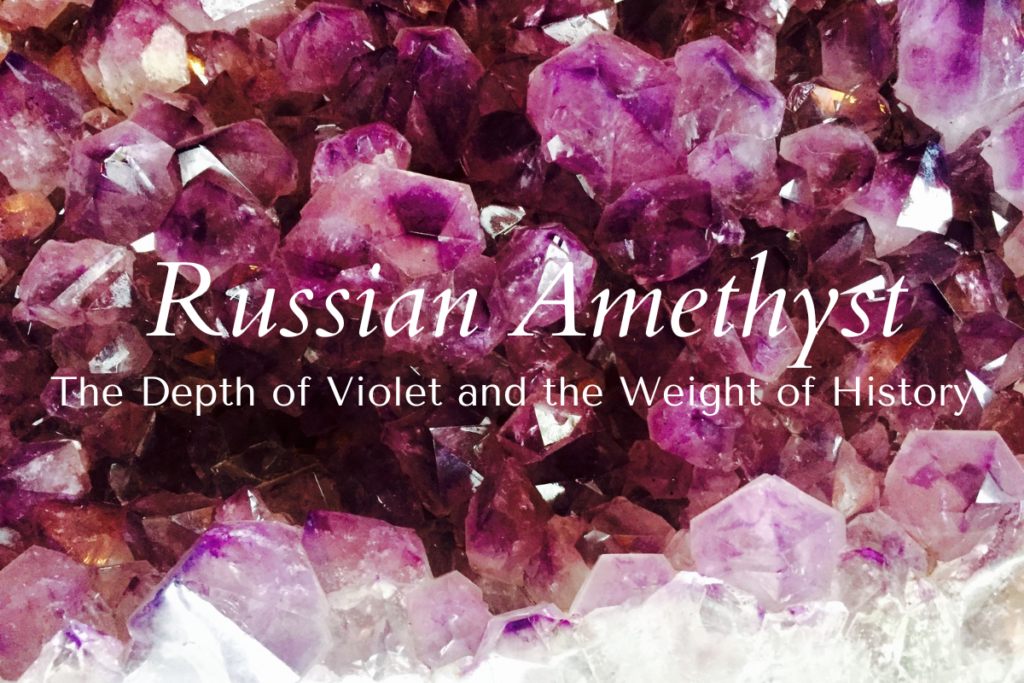
Russian Amethyst: The Depth of Violet and the Weight of History
From the frost of the Urals to the courts of empires, a study in colour, geology, and restraint.
At the Russian imperial court, violet was never ornamental. It signified authority. In the 18th century, amethyst from the Ural Mountains entered the collections of the Tsars and the Orthodox Church, reserved for high nobility and sacred objects. Before Brazil transformed global supply, Russian material was among the most valued coloured stones in Europe.
Amethyst is quartz. On paper, that sounds almost ordinary. Quartz is abundant, chemically simple — silicon dioxide with traces of iron. But origin changes character. And Russia, particularly the Ural region, gave the world a standard of violet that redefined what amethyst could be.
When I speak about Russian amethyst, I am not speaking about romance. I am speaking about geology, empire, and a colour that once stood beside ruby and sapphire at royal courts.
The Ural Mountains — Where It Began
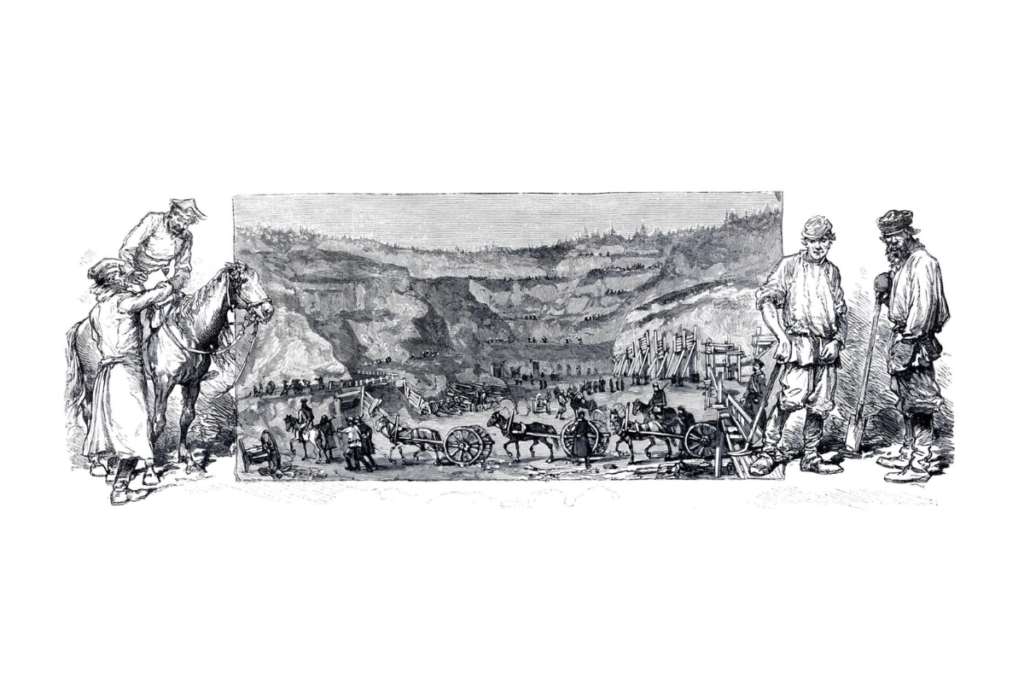
The historic deposits that built Russia’s reputation lie in the Ural Mountains, the long geological spine that separates Europe and Asia. The most important occurrences are found near Murzínka, Vatikha, and Mursinka in the Middle Urals, close to present-day Yekaterinburg.
These deposits were discovered in the 18th century and quickly became known for producing intensely saturated material. Unlike the paler amethyst from many other regions, Ural stones displayed a deep violet bodycolour with distinct reddish secondary flashes. Under daylight, they remained rich. Under candlelight — and this mattered in imperial Russia — they warmed.
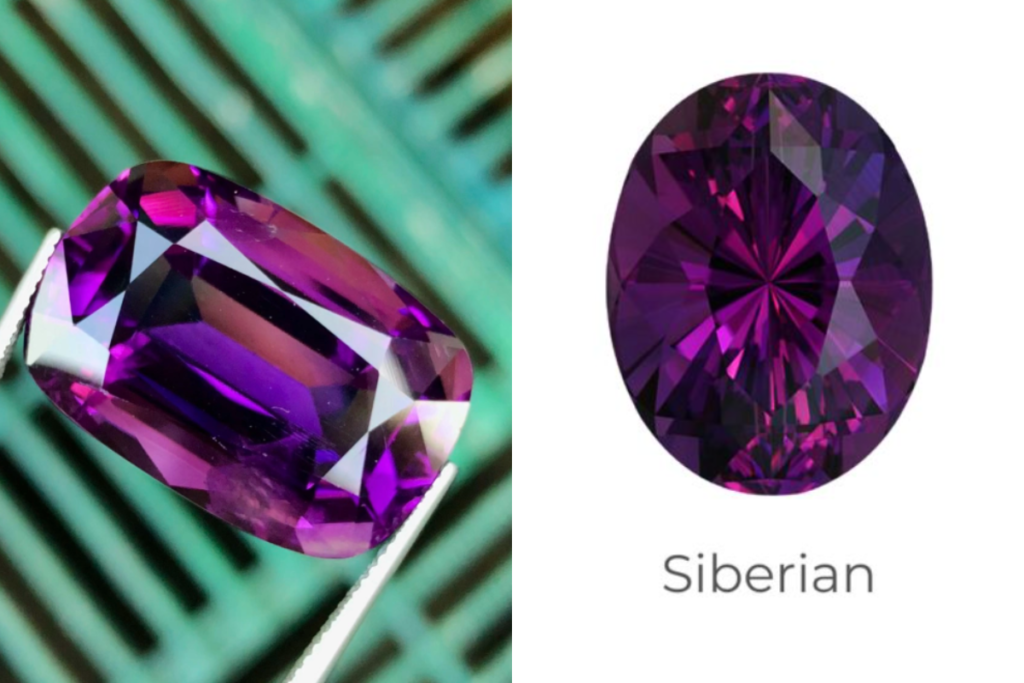
Further north, in Siberia, additional deposits were identified, though production volumes were never vast. The term “Siberian amethyst” became shorthand in the trade not for geography alone, but for colour quality: strong violet with red and blue flashes, high saturation, minimal grey.
Today, large-scale production from these historic Ural mines is limited. The deposits are not exhausted, but they are no longer prolific. Modern Russian material appears sporadically. Most fine stones on the market with true Ural provenance come from older collections.
That scarcity is part geology, part history.
Why Russian Amethyst Was Once Worth More Than Diamond
In the 18th and early 19th centuries, amethyst was not considered a semi-precious stone. That classification came later, after major deposits were discovered in Brazil and the market was flooded with accessible material.
Before Brazil’s discovery of vast geodes in Minas Gerais, fine amethyst was rare. Russian material dominated European supply. Catherine the Great commissioned amethyst pieces for court. Russian nobility wore it in parures alongside diamonds. The gem’s purple echoed imperial symbolism — power, restraint, authority.
At that time, large, richly coloured crystals were difficult to source. Transport was complex. Cutting technology was limited. A fine Russian amethyst could command a price comparable to ruby in certain markets. The valuation was based on rarity of colour and access.
Then Brazil entered the story.
Brazilian amethyst, discovered in the 19th century, was abundant. Beautiful, yes — but widely available. Prices shifted permanently. Amethyst moved from royal exclusivity to accessible elegance.
Russian material retained prestige because of colour intensity. But its price structure changed with global supply.
Markets are practical. History is not sentimental.
What Makes Russian Amethyst Different
Chemically, amethyst is quartz with trace iron. The violet colour forms when iron impurities are irradiated naturally within the crystal lattice. Heat exposure alters this structure, which is why amethyst can turn yellow (becoming citrine) if heated.
Russian material is distinguished primarily by colour saturation and balance.
The finest examples show:
- Deep violet primary hue
- Secondary red flashes
- High saturation without blackening
- Minimal brown or grey modifiers
- Even colour distribution
Tone matters. Too dark, and the stone appears inky. Too light, and it loses authority. The best stones hold medium-dark tone with internal luminosity — light enters, moves, and returns.
Clarity is usually good in amethyst. Eye-visible inclusions are uncommon in fine pieces. Some stones display colour zoning — angular bands within the crystal. In high-end cutting, orientation is critical to minimize this.
Amethyst has a refractive index around 1.544–1.553 and hardness of 7 on the Mohs scale. Durable enough for daily wear. Not indestructible.
I always examine it in daylight. Under neutral light, true saturation reveals itself. Artificial warm lighting can flatter mediocre stones.
Light tells the truth.
Treatments — What You Must Know
Most amethyst on the market is untreated. That is one of its advantages as a gem. The violet colour forms naturally and does not typically require enhancement.
However, two treatment-related realities exist:
- Heat treatment — Used to convert amethyst to citrine or deepen certain tonalities. This is common in lower-grade material.
- Irradiation — Rarely applied today for amethyst specifically, but historically used in quartz varieties.
When buying Russian-origin stones, the primary concern is not treatment, but mislabeling of origin. “Siberian” is often used as a colour description, not as geographic proof.
If origin matters for your collection, request documentation from a reputable laboratory such as GIA or SSEF. Even then, origin determination in quartz is complex and not always definitive.
Do not rely on trade language alone.
Rarity Today
Here is where clarity is important.
Amethyst itself is not rare globally. Brazil, Zambia, Uruguay, and Madagascar produce significant quantities.
True historic Russian material from the Urals — fine colour, documented origin — is rare in the market.
Large stones above 10 carats with strong saturation and even tone are increasingly difficult to source from Russian deposits. Most appear through estate pieces or old stock.
If a dealer presents abundant “Russian” stones in identical calibrated sizes, question it. Natural mining does not produce factory-consistent goods.
Rarity is about combination: origin, colour quality, size, and documentation.
Remove one element, and rarity changes.
Sourcing 101 — What I Look For
When I buy amethyst — Russian or otherwise — I evaluate in this order:
Colour first. Always.
Then tone.
Then distribution.
Then cut.
If colour is not right, nothing else compensates.
For Russian material, I want medium to medium-dark violet with red flashes visible under white light. Not brown. Not grey. Not flat.
The stone should feel alive when rotated. If it turns black under slight tilt, it is too dark.
Cut matters more than people admit. Amethyst is pleochroic. It can show lighter and darker axes. A skilled cutter orients the crystal to maximize saturation without extinction.
I avoid overly shallow cuts. They window. I avoid overly deep cuts. They trap light.
Clarity is usually straightforward — eye-clean is achievable. Minor inclusions are acceptable if colour is exceptional.
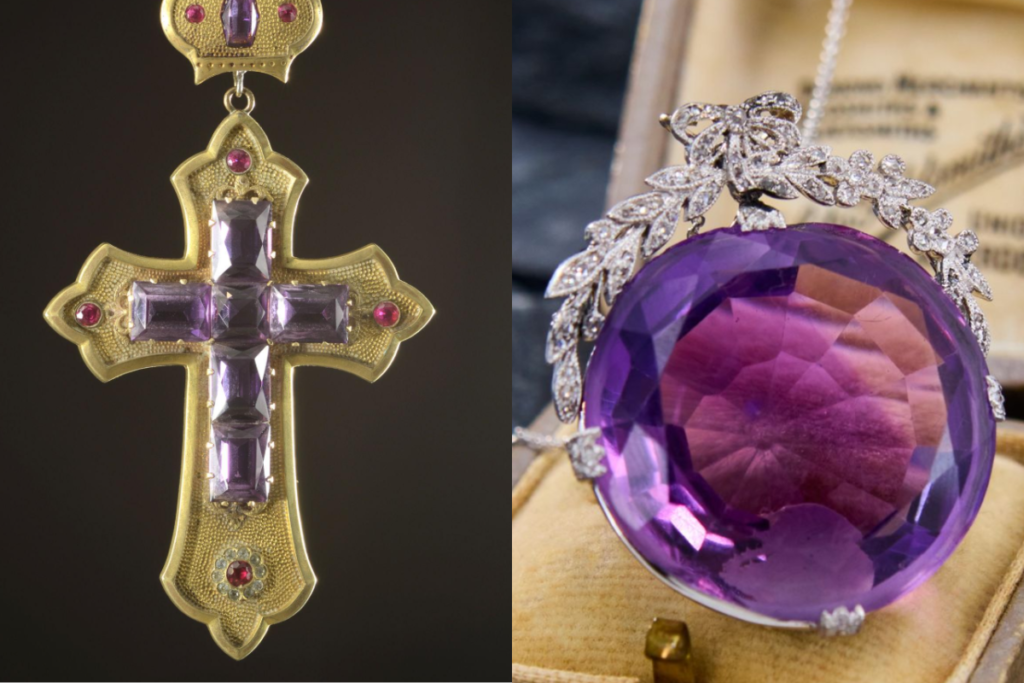
Historical Pieces — Why They Still Matter
In Imperial Russia, amethyst was not decorative excess. It was deliberate symbolism. The Russian Orthodox Church used it extensively in ecclesiastical objects — pectoral crosses, episcopal rings, reliquaries, chalices — because purple carried theological weight. It signified spiritual authority, repentance, and inner clarity. Set against gold and enamel, the violet created a controlled contrast that felt solemn rather than ornamental. Many surviving liturgical jewels from the 18th and 19th centuries show large, saturated amethysts framed in restrained gold work, allowing the colour to function almost as a field of presence rather than a sparkle.
At the Tsarist court, the stone moved from altar to palace. Parures combining amethyst and diamond appeared in the 19th century, particularly during the reigns of Alexander I and Nicholas I, when court jewellery leaned toward structured symmetry. The pairing was intentional: diamond provided light and definition; amethyst provided depth. The contrast was architectural. In candlelit halls, the violet read as dignified rather than flamboyant.
Beyond Russia, Georgian and later Victorian jewellers embraced amethyst for similar reasons. Georgian pieces often used closed-back settings and foiled stones to intensify colour, while Victorian designs favored step cuts and oval forms that emphasized saturation over brilliance. These were not stones cut to scatter light wildly. They were cut to hold it. The geometry supported depth.
Modern Relevance — February, Aquarius, and why I choose it
As the February birthstone, amethyst never really leaves the conversation. It belongs to winter — to clarity, to still air, to that sharp light that comes after snow. Astrologically it is linked to Aquarius, a sign associated with intellect, independence, and vision that runs slightly ahead of its time. Across centuries, amethyst has also been tied to protection, sobriety, and heightened awareness. In Greek tradition it guarded against intoxication. In medieval Europe it was believed to sharpen the mind and strengthen spiritual perception. Some cultures associated it with intuition, psychic sensitivity, and the ability to see beyond illusion. Whether one believes in these properties or not, the symbolism persists because the colour itself feels contemplative — inward, lucid, steady.
In today’s market, amethyst is widely available, but not all amethyst is equal. If one chooses to invest in this stone — emotionally or materially — Russian material remains the benchmark. The depth of violet, the subtle red undertone, the historical lineage from the Urals: these elements give it weight beyond carat size. Among all amethysts, a fine Russian stone carries the strongest combination of colour authority and historical resonance. If you are going to choose violet, choose the one that set the standard.