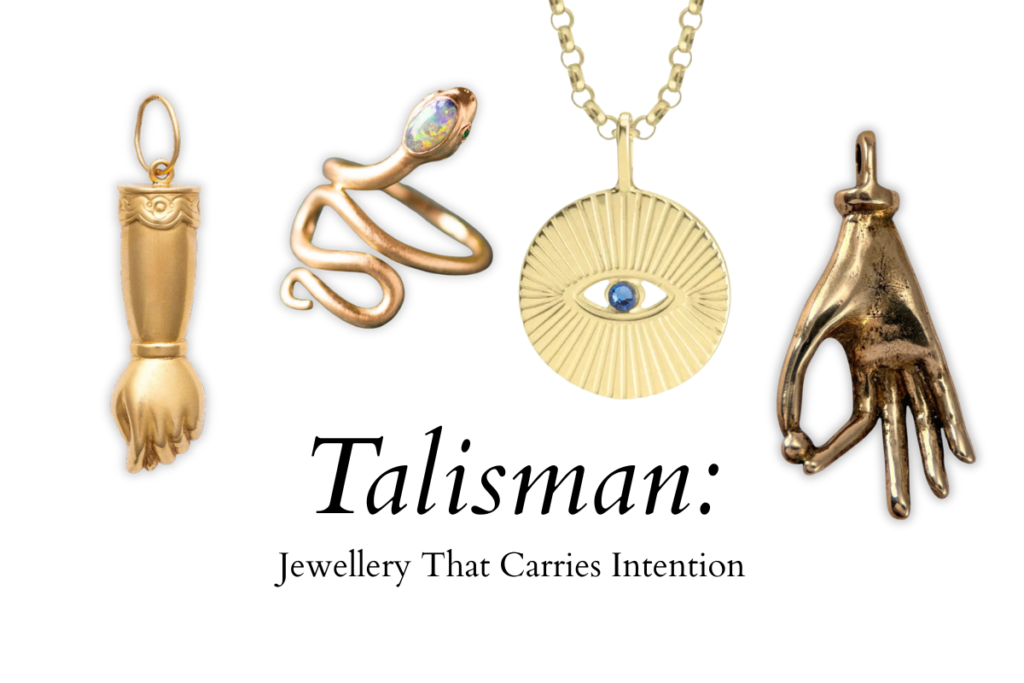
Talisman: Jewellery That Carries Intention
A historical perspective on why we have always worn more than decoration
If you take the time to read historical sources carefully — not only royal inventories or museum catalogues, but also burial records, early medical texts, and trade writings — a very different understanding of jewellery begins to take shape. What we now classify as adornment was, for most of human history, something far more integrated into daily life.
Jewellery was not created primarily to be seen. It was created to be used.
Across ancient Egypt, Mesopotamia, Greece, Rome, and later throughout medieval Europe and the Islamic world, objects worn on the body were expected to serve a purpose that extended beyond appearance. They were used to protect against illness, to secure safe passage during travel, to reinforce authority, or to influence outcomes in situations where direct control was impossible. Jewellery belonged to the same space as medicine, ritual, and personal belief — a quiet but constant attempt to manage uncertainty.
This is what makes the subject of talismans still relevant today. Not because we continue to follow the same systems of belief, but because the structure of the relationship between object and wearer has not disappeared. It has simply changed language.
Once you understand that jewellery was originally functional — not in a mechanical sense, but in a human one — many contemporary behaviours that seem instinctive or irrational begin to feel consistent with a much older logic.
Talisman and amulet — a necessary distinction
The distinction between talismans and amulets is often reduced to semantics, but historically it reflects two very different intentions.
An amulet is defensive in nature. Its role is to protect, to create a boundary between the wearer and something perceived as harmful, whether that is illness, misfortune, or external threat. It operates by exclusion — by keeping something away.
A talisman, on the other hand, is not limited to protection. It is directional. It is selected or created to attract, reinforce, or amplify a specific quality or outcome, such as strength, clarity, authority, or fertility. Where the amulet resists, the talisman engages. It does not only prevent; it encourages.
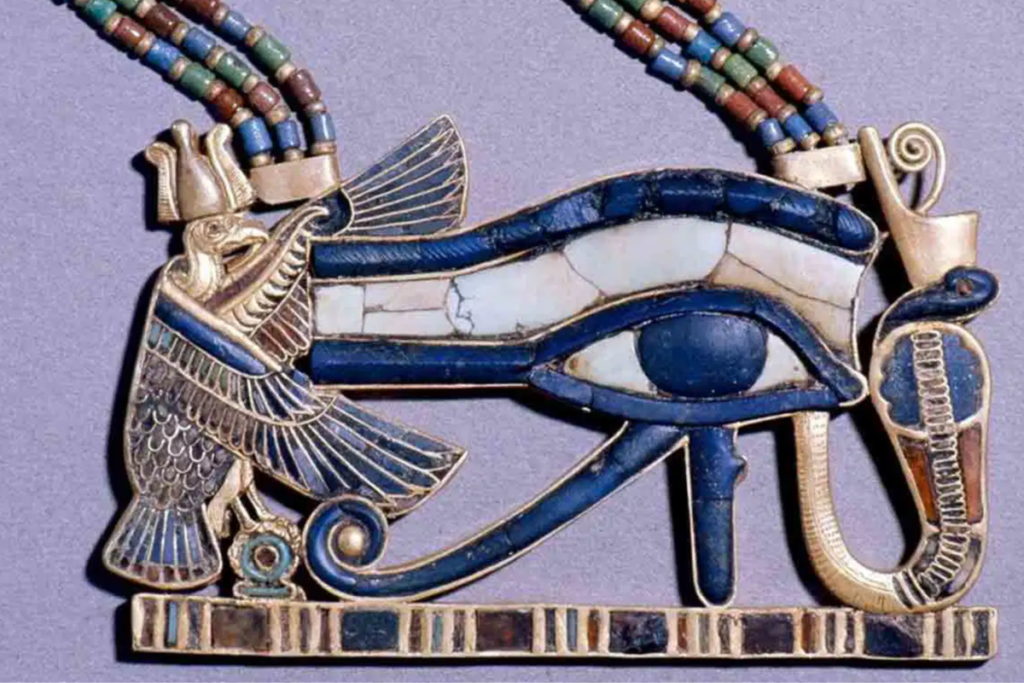
This distinction appears across cultures even when the terminology changes. In ancient Egypt, for example, protective amulets such as the Eye of Horus were placed on the body to guard the wearer, while other objects — such as scarabs — were used in a more active way, associated with transformation and continuity. The intention behind the object shaped both its form and its use.
Understanding this difference allows you to read historical jewellery more precisely. It shifts the focus from what an object looks like to what it was expected to do.
Jewellery as a tool in early civilizations
In early civilizations, jewellery cannot be separated from the systems of thought that structured daily life. It was not an independent category of design, but part of a broader attempt to understand and interact with the world.
Egyptian jewellery offers one of the clearest examples of this. Materials were selected with intention rather than preference. Lapis lazuli, with its deep and stable blue, was associated with permanence and the divine. Carnelian, dense and red, was linked to vitality. Turquoise was connected to protection and regeneration. These associations were not decorative. They were functional.
Placement on the body was equally deliberate. Objects were worn at the throat, over the heart, on the wrists — areas considered points of vulnerability or significance. The body was not neutral; it was part of the system in which the object operated.
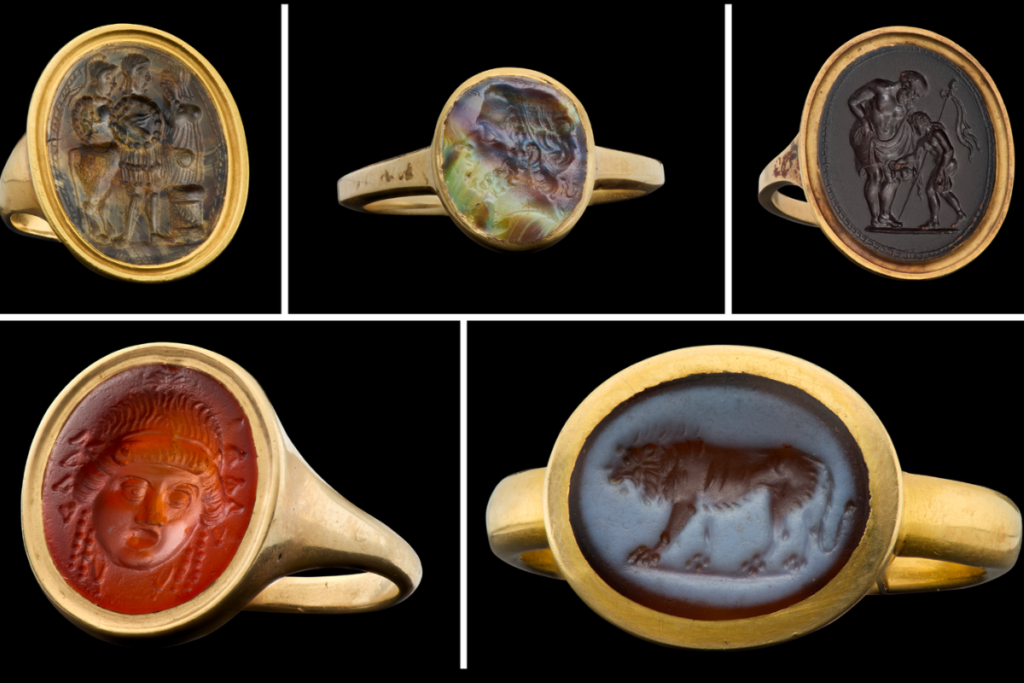
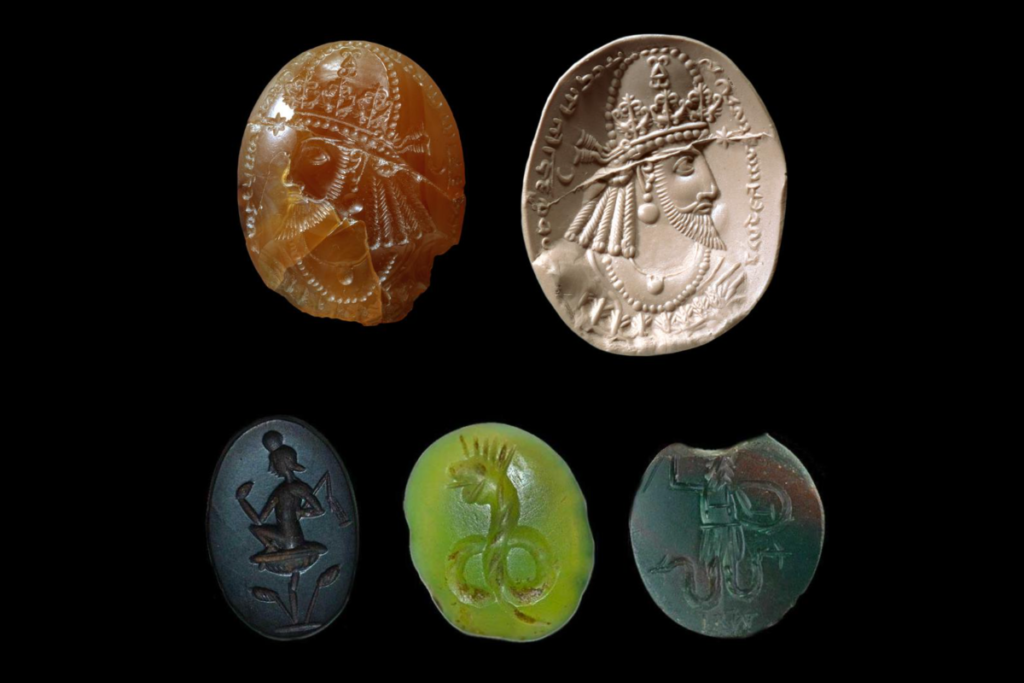
A similar logic appears in Mesopotamia, where cylinder seals worn as pendants functioned both as identifiers and protective devices, and in Greece and Rome, where engraved gemstones carried images or symbols believed to influence the wearer’s life. Jewellery, in this context, was not separate from daily existence. It was one of the ways people navigated what they could not control.
Why gemstones became central
The central role of gemstones in talismans follows from their material properties.
A gemstone is stable. Its colour remains consistent over time. Its internal structure does not shift. Compared to organic materials, it offers a sense of permanence that is immediately perceptible. That stability made it a natural carrier for meaning.
Over time, observations about stones developed into structured systems. Blue stones that retained their depth under light were associated with constancy and protection. Red stones, visually connected to blood, were linked to vitality and strength. Green stones, tied to vegetation, were associated with renewal and growth.
By the medieval period, these associations were formalised in lapidaries — texts that described the properties of stones and their expected effects on the wearer. Sapphire was linked to protection and clarity, emerald to vision and foresight, garnet to protection during travel. These texts were not written as metaphor or symbolism. They were practical references.
A stone was expected to act.
The importance of contact
One aspect that tends to be overlooked today is the way these objects were physically used.
Talismans and amulets were not designed for preservation. They were worn continuously, often in direct contact with the skin. The object did not function independently; it operated in relation to the body.
This explains the wear visible on historical pieces. Rings with softened edges, pendants smoothed on the back, engravings that have partially faded over time. What we would now consider damage was, in fact, evidence of use.
The value of the object did not lie in maintaining its original condition, but in maintaining its connection to the wearer. The longer it was worn, the more it fulfilled its purpose.
Forms that remain unchanged
Certain forms of jewellery have persisted precisely because their function has not fundamentally changed.
The signet ring, for example, originally served as a tool for sealing documents and establishing identity. Worn daily, it became inseparable from the individual. Its role extended beyond administration into something more personal.
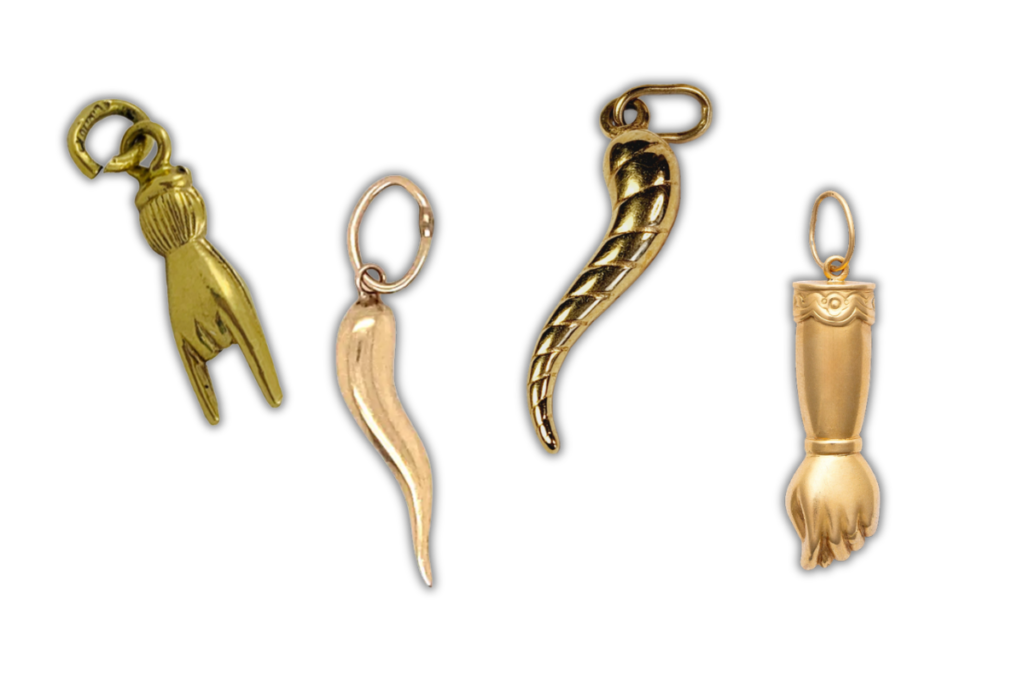
Religious medals and crosses continue to operate in a similar space, combining protection with a constant point of reference. They are worn consistently, often without conscious thought, becoming part of the body’s routine.
In Islamic traditions, engraved rings and pendants carried inscriptions intended to protect and guide, while in Renaissance Europe, talismans were sometimes created according to astrological timing, aligning materials and symbols with specific moments.
Across cultures, the principle remains consistent. The object is not external. It is integrated.
Reading jewellery differently today
If jewellery is approached only as decoration, many of these historical practices can appear distant or symbolic in a way that feels disconnected from contemporary life.
If it is approached as functional, those same practices become coherent.
The repeated use of certain stones across cultures begins to make sense. The persistence of specific forms feels logical rather than traditional. The tendency to wear certain pieces continuously, while others remain occasional, reflects a pattern that has existed for centuries.
Jewellery has always existed at the intersection of material and intention.
Even today, the way people interact with jewellery follows this structure. Some pieces are worn daily without question, becoming almost invisible through familiarity. Others are tried and set aside. Some objects are kept close without a clear explanation, yet remain difficult to replace.
We may no longer describe this in terms of protection or influence, but the underlying relationship between object and wearer — the sense that a piece can hold something beyond its material — remains present.
Jewellery as a personal talisman
This is where the idea of the talisman becomes interesting again, not as a historical concept, but as a way of understanding how jewellery functions today.
It is not necessary to assign fixed meanings to stones or to follow structured belief systems for jewellery to carry significance. What matters is how a piece is used over time.
A piece becomes important through repetition. Through presence. Through the fact that it remains on the body across different moments — ordinary days, periods of change, moments of uncertainty. Over time, it becomes associated with those experiences.
That association is enough.
A simple ring can become a point of stability, not because of what it is made of, but because it is always there. A pendant can become something you reach for without thinking, a small and constant reference point. Even a stone chosen without a clear reason can become the one you return to repeatedly.
In that sense, almost any piece of jewellery today can become a talisman.
Not because it was designed with that intention, but because it is allowed to take on that role through use.