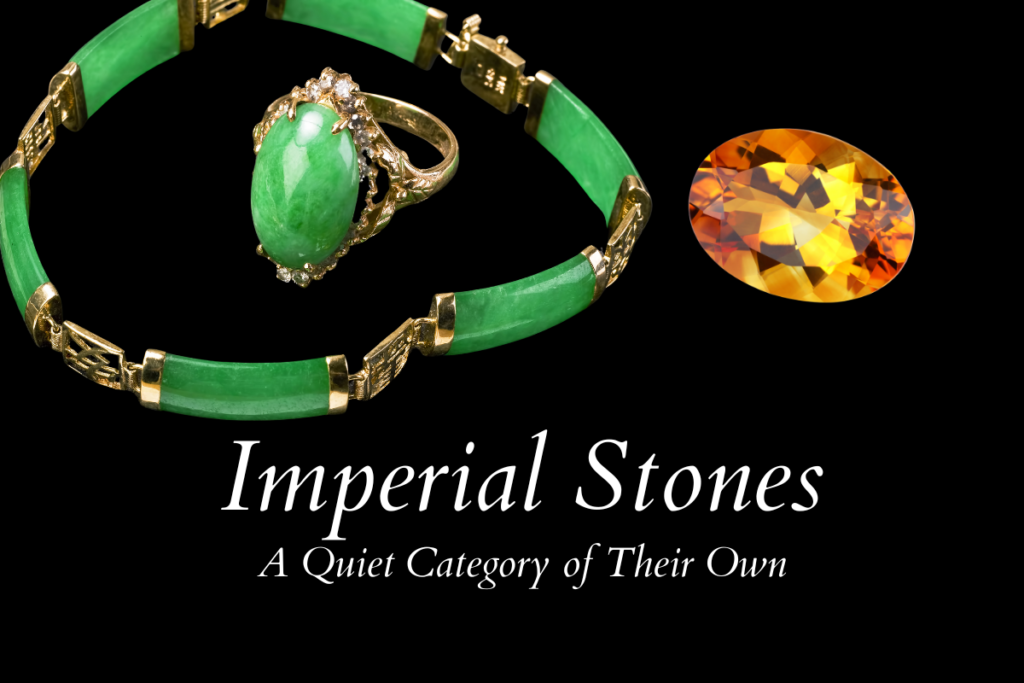
Imperial Stones: A Quiet Category of Their Own
On topaz, jade, and zircon — and why some of the most valuable stones are the least discussed
I’ve always been drawn, almost instinctively, to what are called imperial stones. Not because of the word itself, but because of the type of presence these materials carry. They don’t try to attract the attention of the masses. Their presence sit, quite calmly, and yet represents a completely different category of luxury.
Over time, I’ve come to think that they indeed deserve to be considered as a category of their own. Not in a formal gemmological sense, but in the way we read them. They are rare, often difficult to source correctly, and priced in a way that only starts to make sense once you understand what you are actually looking at.
They are also, for the most part, overlooked. Not actively ignored, but not fully understood either. They are not for mass production and for mass making jewellery.
And yet, to me, they represent one of the clearest expressions of luxury. Not the visible kind, not the one that needs to be recognized immediately—but the quieter version. The one that operates on knowledge. If you know, you know.
The word imperial has been used in jewelry for centuries, but not always with precision. It doesn’t describe a mineral. It describes a position—something rare enough, stable enough, and culturally embedded enough to sit within systems of authority. It’s a term shaped as much by history as by geology.
Three stones are consistently associated with it: topaz, jade, and—more loosely and unofficially—zircon. Each arrived at that designation through a different path. Each carries its own logic.
Imperial Topaz
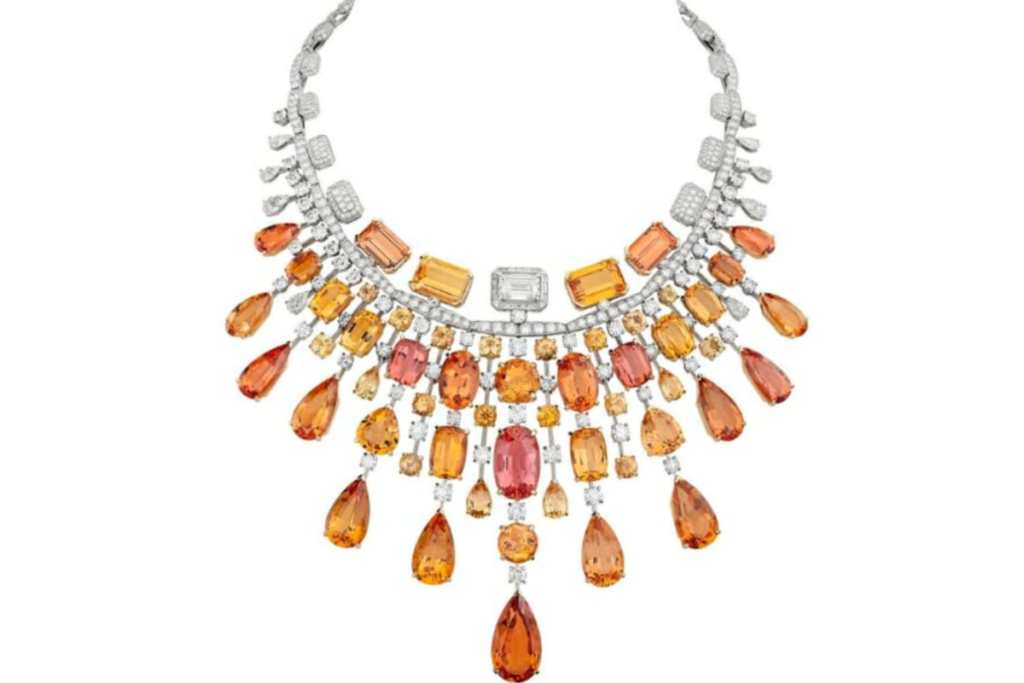
Imperial topaz is one of the few stones where the term imperial has a precise historical and geographical meaning. It is closely tied to the deposits of Ouro Preto in Brazil, a region that has been producing this material since the eighteenth century. The name itself is not decorative; it reflects a period when the finest stones were reserved for the Portuguese imperial court. Ownership was controlled, and access defined value.
When I look at imperial topaz, I am not looking for brightness in the way one might with a diamond. I am looking at how the color holds itself. The most interesting stones sit in a very specific range—an orange base that carries either a golden warmth or a subtle pink undertone, depending on how the light moves across it. The balance is quite delicate. If the tone shifts too far into yellow, the stone loses depth. If it leans into brown, it becomes heavy and closed.
What makes this material particularly interesting is that, at its best, it does not rely on treatment to define its identity. Fine imperial topaz is generally untreated, and this is not incidental—it is part of its value structure. While some lower-quality stones may be gently heated to improve tone, the market is very clear in distinguishing between natural and altered material, and the difference is reflected directly in price.
Rarity here is not only about how much material exists, but how little of it meets the right conditions. The Ouro Preto deposits are limited, and they have been worked for centuries. Finding stones with both strong color and good clarity, especially above a few carats, becomes increasingly difficult.
What makes imperial topaz a form of low-profile luxury is precisely this combination of factors. It does not perform in an obvious way, and it does not announce its value immediately. But once you understand the constraints—of origin, of color, of treatment—you begin to see why the finest examples sit where they do in the market.
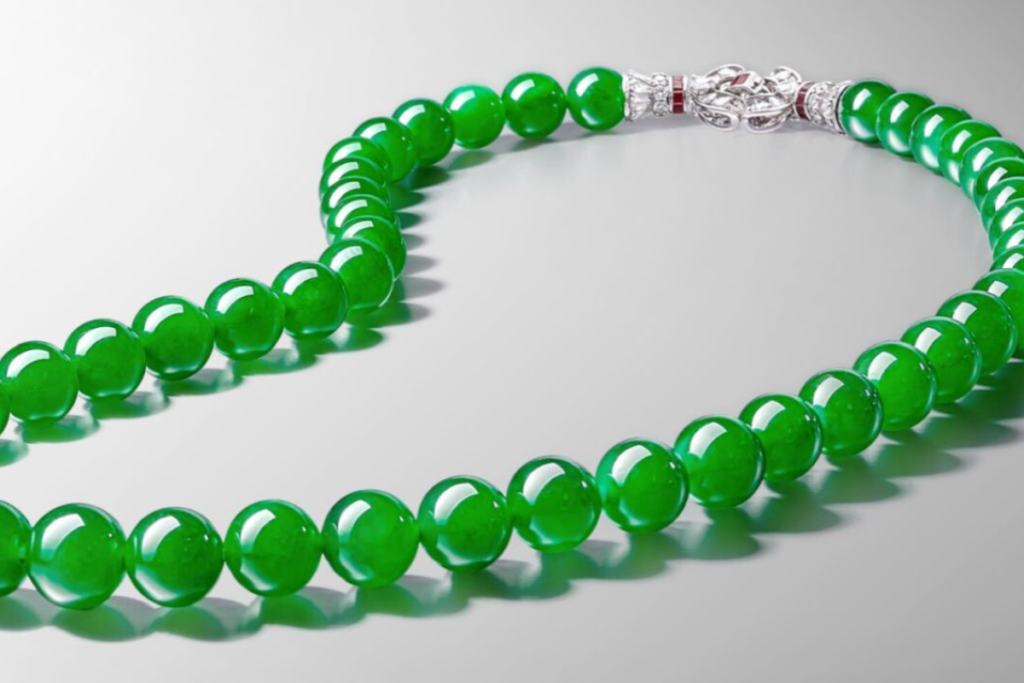
Imperial Jade
Jade operates on a different logic entirely. Even the term itself requires clarification, as it encompasses two distinct minerals: jadeite and nephrite. When we speak about imperial jade, we are referring specifically to jadeite of the highest quality, historically sourced from Myanmar.
The association with the word imperial is rooted in Chinese history. For centuries, jade was not considered a decorative material in the Western sense, but something closer to a cultural constant—linked to ideas of virtue, continuity, and authority. When jadeite from Myanmar entered China during the Qing dynasty, its vivid green color and fine translucency elevated it above nephrite, and the finest pieces were absorbed into imperial use.
The value of jade does not come from brilliance or reflection, but from structure. When I examine jadeite, I am looking at how the material is built internally. The color must be present, of course—a saturated green, often slightly cool, created by traces of chromium—but color alone is not enough. What matters is how evenly that color is distributed, and how the internal texture allows light to pass through and diffuse softly.
This is where the distinction between treated and untreated material becomes critical. A significant portion of jadeite on the market has undergone processes such as bleaching and polymer impregnation to improve its appearance. While these treatments can produce visually appealing stones, they alter the internal structure in a way that removes them from the category of collectible material.
Natural jadeite, often referred to as Type A, has not undergone such treatments. Its color and structure are entirely the result of geological formation. The difference between treated and untreated jade is not subtle, either in terms of material integrity or market value. It is the difference between something that has been adjusted to look right and something that inherently is.
Sourcing jade of this level requires a different kind of discipline. Myanmar remains the primary source, but access is complex and heavily restricted. Even once material enters the market, the majority of it must be excluded after careful analysis. What remains is a very narrow selection of stones that meet the criteria.
What makes imperial jade particularly interesting is that its value is not immediately legible. To someone unfamiliar, it can appear simple, even understated. But once you understand how to read its structure—its grain, its translucency, the way light settles inside it—it becomes one of the most demanding materials to evaluate.
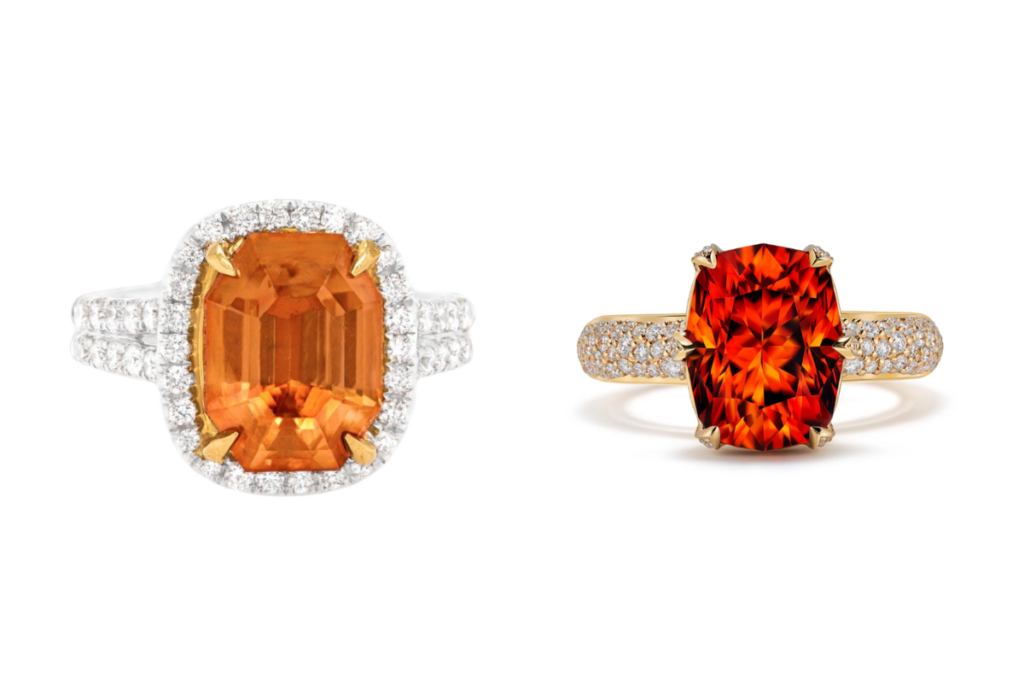
Imperial Zircon
Zircon occupies a more complicated position. It is a natural gemstone with a long history, found in regions such as Cambodia, Sri Lanka, and Myanmar, yet it is often misunderstood due to its name. The similarity in the name to cubic zirconia, which is synthetic, has affected its perception for decades.
The term imperial zircon is not formally defined within gemology. It is a trade expression, used to describe zircon in warm tones—golden, orange, sometimes with subtle red modifiers—that visually align with the palette of imperial topaz.
From a strict standpoint, it is a constructed term. But it is not without purpose.
Zircon has strong optical properties, including high dispersion and noticeable double refraction, which gives it a particular kind of internal movement when cut well. It does not behave like diamond; the light does not return in a sharp, single direction, but rather appears layered, almost slightly softened.
Color plays a central role in how zircon is perceived. Blue zircon, for example, is almost always the result of heat treatment applied to brown material. These treatments are stable and widely accepted, but they also define how the stone is categorized.
The warmer tones—the ones sometimes described as imperial—are less frequently treated, and when found in good quality, they offer a different reading of the material. They feel more grounded, less reliant on optical performance.
Rarity here is relative. Zircon is more available than imperial topaz or jade, but fine material in larger sizes, with clean color and good cutting, is not as common as the market perception might suggest.
There is no tradition of soaking zircon, as the material does not require it structurally.
What makes zircon a low-profile luxury is not its inherent rarity, but its misrecognition. Many people assume it is synthetic, or dismiss it without understanding what it is.
This is where the use of the term imperial becomes interesting. It is, in a sense, a way of repositioning the stone—placing it within a visual and conceptual framework that highlights its best characteristics rather than its misunderstandings.
It shifts the conversation.
Instead of explaining what zircon is not, it allows you to show what it is.
My Closing Thoughts
I think we should start looking for these stones more actively. Not as alternatives to more established categories, but as materials that already carry a strong identity and simply require the right context to be understood.
They are not easy to find in their best form. That difficulty comes from multiple layers—limited geological sources, strict quality filters, and, in the case of jade, a market where most available material must be excluded before you even begin selecting.
This naturally places them in a position that aligns well with collecting. Not because they are inaccessible, but because they demand attention and knowledge.
And then there is something less tangible, but just as important. These stones do not explain themselves. They do not try to be immediately recognized. You either see it, or you don’t.
In a market where visibility is often mistaken for value, that becomes a very specific kind of advantage. The kind that doesn’t need to be stated. If you know, you know.