
Diamond Origins: Mines, Types, and the Hidden Structure Behind the April Birthstone
On origin, structure, and the quiet differences that define the rarest stones
Why Diamonds Became the Most Popular Gemstone
Diamonds are, without question, the most recognized gemstones in the world. Not by accident. Decades of marketing built that position carefully, until the diamond became almost synonymous with commitment, permanence, and value.
And yet, if you strip all of that away, what remains is still compelling.
A material that formed deep within the Earth over millions — sometimes billions — of years. A crystal that can take extraordinary pressure without breaking. A surface that handles light in a way few materials can, reflecting it back with sharpness and clarity. There is a reason people trust diamonds. Not because they were told to, but because the stone itself holds that quality.
Still, the public conversation tends to stop at the surface — at brilliance, at sparkle, at size.
What interests me is what comes before that.
Because a diamond does not begin as something bright. It begins as something buried, structured, and specific. And the differences that matter most are already there long before the stone is cut.
How Diamonds Form Deep Within the Earth
Most diamonds formed at depths of around 140 to 200 kilometers beneath the Earth’s surface, in the mantle. Not just under pressure, but under stable pressure. That detail is important. Stability is what allows carbon atoms to arrange themselves into a rigid, repeating structure. Without that, the crystal doesn’t form correctly.
But formation is only part of the story. The second part is transport.
Diamonds reach the surface through volcanic events, carried by magma in what we call kimberlite or lamproite pipes. These are not slow processes. They are violent, rapid, and rare. Without them, diamonds would remain where they formed — inaccessible.
Each of these pipes has its own geological fingerprint. And that fingerprint determines what kind of diamonds it brings to the surface.
Diamond Mines Around the World and What They Produce
In Siberia, for example, the Mirny Mine has produced large quantities of diamonds over decades. Many of these stones fall into what we classify as Type Ia — diamonds that contain nitrogen within their structure. This nitrogen often affects color slightly, introducing faint yellow tones even when the stone appears close to colorless.
Move to southern Africa, and the profile shifts.
At the Jwaneng Mine and Orapa Mine, the consistency of crystal formation is remarkable. These deposits produce a broad range of qualities, but what stands out is how well many of these diamonds respond to cutting. The internal structure tends to be stable, allowing for precise facet alignment and strong light return.
Then there are deposits that sit outside the norm.
The historical Golconda region is one of them. The mines themselves are no longer active in a modern sense, but their output shaped how we understand exceptional diamonds. Many stones from Golconda are classified as Type IIa — diamonds with almost no measurable nitrogen or boron. Chemically, they are close to pure carbon.
You can see it immediately when you compare them side by side with other diamonds. There is a kind of transparency that feels uninterrupted. Light doesn’t scatter in the same way. It moves through the stone more directly.
Modern parallels exist, though they are rare.
The Letseng Mine is one of the few places still producing significant Type IIa material today. Not in large volumes, but with a consistency that has made it known for large, high-quality stones. When I look at exceptional white diamonds in the current market, this is often where they originate.
Diamond Types Explained: Type Ia, Ib, IIa, and IIb
Understanding diamonds at this level means looking beyond what is visible and into how the crystal is built.
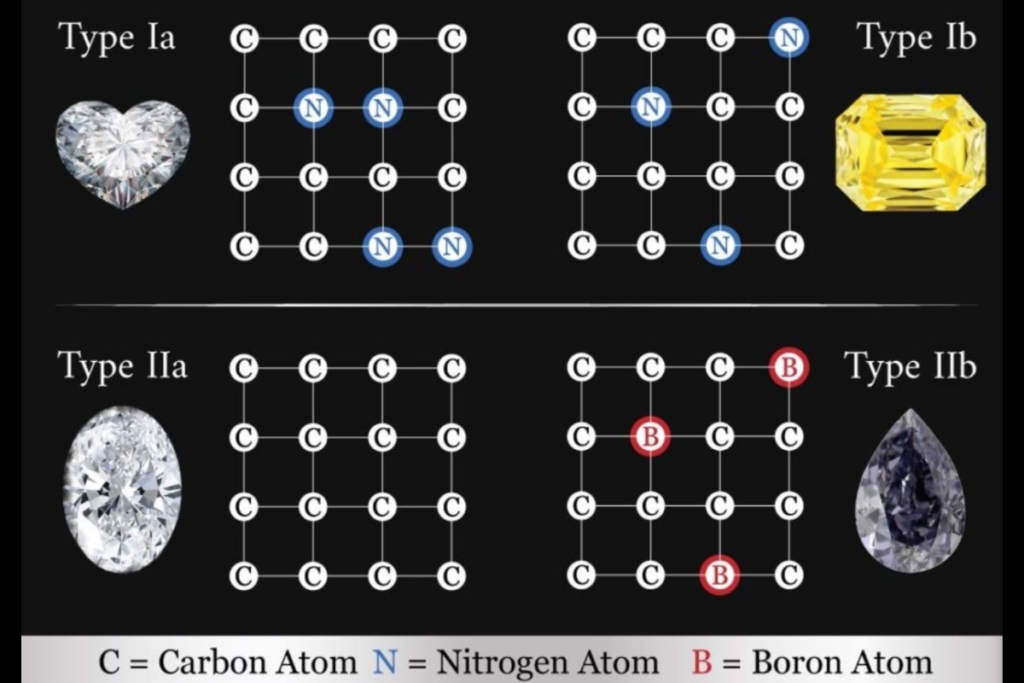
At a basic level, diamonds are classified into two main groups: Type I and Type II. The distinction comes down to trace elements — primarily nitrogen and boron — and how they are arranged within the crystal lattice.
Type I diamonds contain nitrogen. They represent the majority of diamonds found in nature.
Within this group, Type Ia diamonds have nitrogen atoms grouped together. This clustering affects how light is absorbed, often resulting in subtle yellow or brown tones.
Type Ib diamonds, on the other hand, have isolated nitrogen atoms. These are much rarer. They tend to show stronger color saturation, particularly in yellow and orange diamonds. Natural Type Ib diamonds are uncommon enough that when you encounter one, it usually stands out immediately.
Then there is Type II.
Type IIa diamonds contain no measurable nitrogen or boron. They are structurally purer, and that purity affects how they handle light. The transparency is often more direct, less diffused. Many of the largest and most important diamonds ever recovered fall into this category.
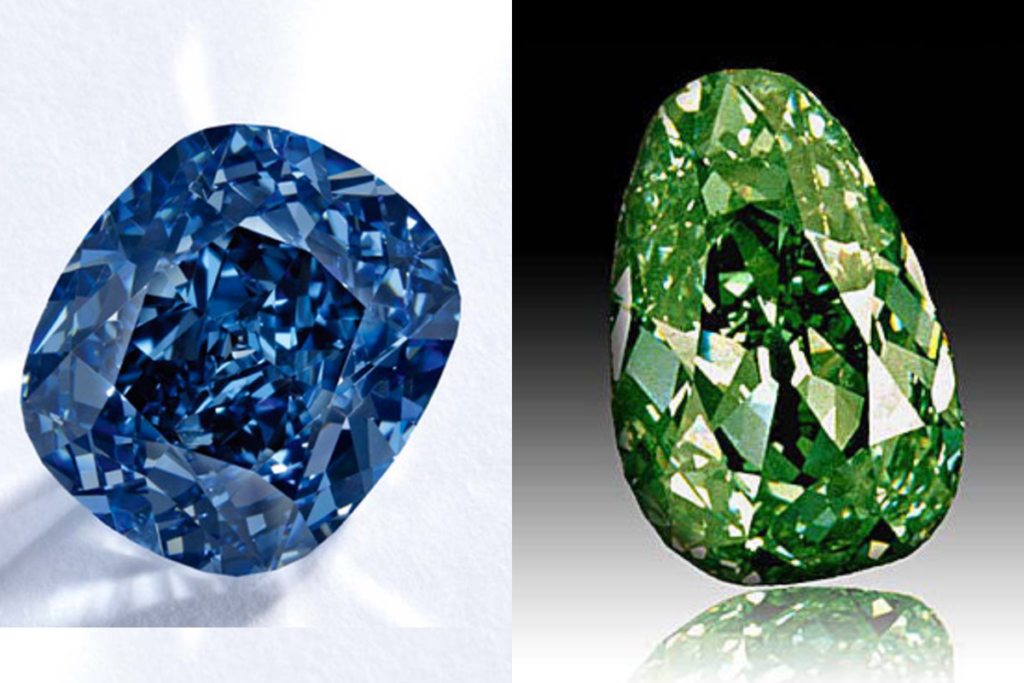
Type IIb diamonds contain boron. This element changes the behavior of the diamond in a fundamental way. It introduces electrical conductivity and, visually, it produces blue coloration.
The Cullinan Mine is one of the most important sources of Type IIb diamonds. When you see a natural blue diamond, especially one with depth of color, you are looking at something that formed under very specific and uncommon conditions.
Colored Diamonds: Origins of Yellow, Blue, Pink, and Green
Color in diamonds follows different rules depending on the type.
Yellow diamonds are generally linked to nitrogen. The more nitrogen present, and the way it is arranged, the stronger the color.
Blue diamonds are linked to boron.
But pink, red, and some brown diamonds come from something else entirely — structural distortion within the crystal.
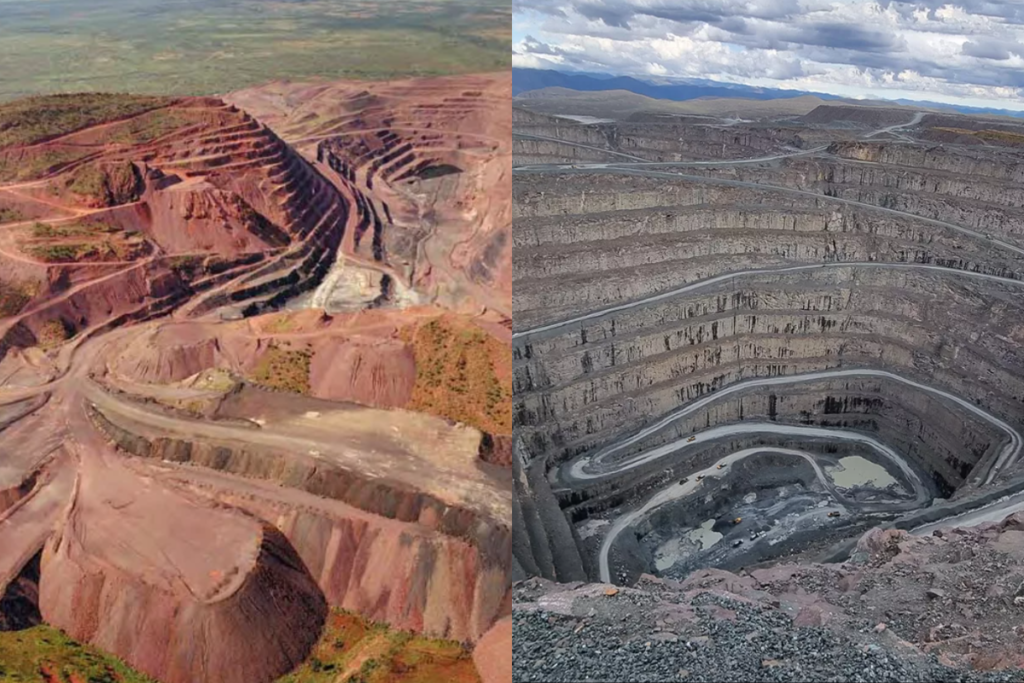
At the Argyle Mine, which closed in 2020, this was particularly evident. Argyle produced a large proportion of the world’s pink diamonds. These stones often show internal graining — a deformation of the crystal lattice — which affects how light travels through them.
The color is not added. It is a result of the structure itself.
Green diamonds form through yet another mechanism. Natural radiation, often from surrounding rocks, alters the outer layers of the diamond. In some cases, this effect penetrates deeper, creating a more uniform color. In others, it remains near the surface, producing a skin of green that may be partially removed during cutting.
Brown diamonds, often overlooked, are also tied to structural deformation. In some cases, they share the same origin mechanism as pink diamonds, but expressed differently.
What Makes a Diamond Truly Rare
When people talk about rarity, they often focus on color alone. Pink is rare. Blue is rare. That is true, but incomplete.
Rarity in diamonds is layered.
A large Type IIa diamond with high clarity is rare in a way that goes beyond color. A Type IIb diamond with stable, even saturation is rare for entirely different reasons. These stones require not only the right chemical conditions, but also the right structural environment over long periods.
And those conditions are not evenly distributed.
Each mine produces a certain profile. Not just in terms of quantity, but in terms of what kind of diamonds are likely to be found there. Some are known for size. Some for color. Some for purity.
This is why origin matters, even when it is not always disclosed in commercial settings.
It tells you what the stone had the potential to become before it was shaped.
Why Two Diamonds Can Look Different Despite the Same Grade
There is something else that becomes clear with experience.
Two diamonds with identical grading reports can behave differently in light.
Part of that is cut. But not all of it.
Some of it comes from the internal structure — from the type, from the way atoms are arranged, from the presence or absence of trace elements.
A well-cut Type IIa diamond often shows a kind of clarity that feels uninterrupted. Light enters and exits without resistance.
A Type Ia diamond, even at high clarity, can show a softer diffusion. Not weaker. Just different.
These are subtle distinctions. They do not appear clearly on paper. But once you see them, they become difficult to ignore.
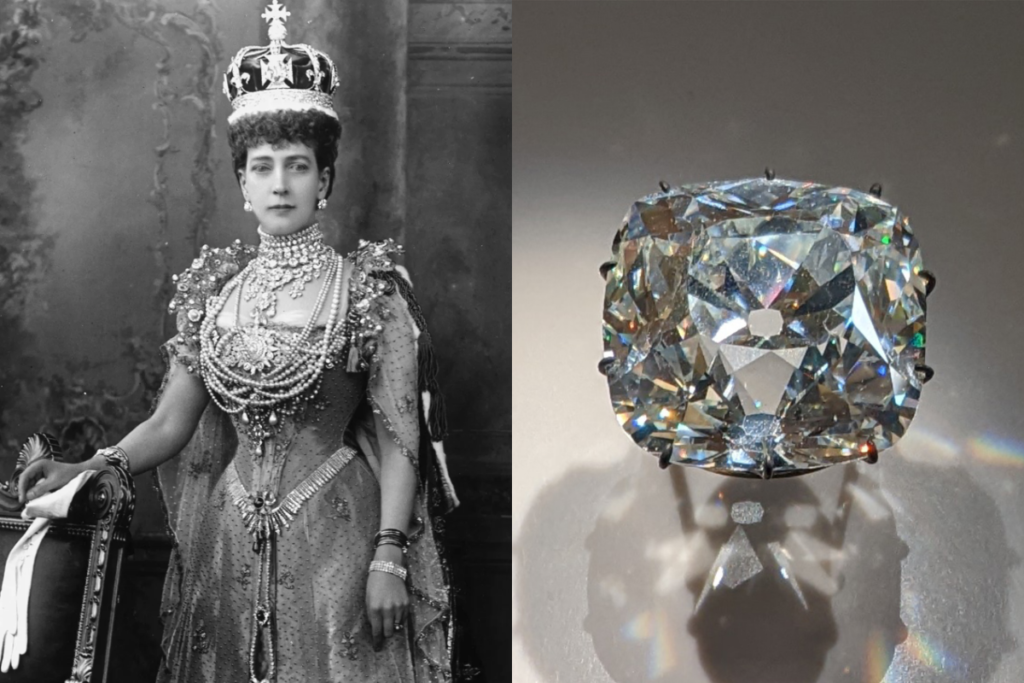
April Birthstone: Why Diamonds Deserve a Deeper Look
April is often reduced to a single idea: diamond as a birthstone. One stone, one message, one simplified narrative.
But the reality is far more layered.
There isn’t just “the diamond.” There are different types, different origins, different internal structures, different geological stories that lead to entirely different outcomes. A Type IIa from Letseng Mine is not the same as a Type Ia from Mirny Mine. A blue Type IIb from Cullinan Mine does not belong in the same conversation as a nitrogen-rich commercial stone, even if both are called diamonds.
That is what makes April interesting to me.
It forces us to look deeper at something we think we already understand.
One stone, yes. But inside it, an entire system — of geology, chemistry, and time — that most people never see. And once you do, the diamond stops being obvious. It becomes something you read, not just something you wear.