Where Color Begins
A synesthetic life, a collector’s eye, and the reason gemstones feel like home
Color has always spoken to me long before I learned the language of gemstones. Long before I understood geology, refraction, trace elements, or the dance between saturation and tone. Before I ever held a loupe or debated the architecture of a cut with a master gemcutter.
I heard color first. I often taste colors. I always see colors when I hear voices and music.
Not as a metaphor — literally. It’s how I am wired.
I grew up seeing colors where other people saw plain sound, plain words, plain moments. Letters had tones. Days of the week carried hues. Certain voices shimmered. Certain feelings arrived as a wash of emerald or a flicker of violet. I didn’t know the term for it then during my MA in Psychology of Communication I learnt it. Synesthesia. I only knew that the world never felt blank to me. It was painted from within.
And somewhere in that sensory landscape, collecting gemstones and jewellery became inevitable.
Before I ever collected stones, I photographed them — or rather, I photographed everything, searching for the exact shade of a fleeting emotion, the precise hue of a moment. My photography teachers used to say I cared too much about color. Color theory was so fascinating. Maybe they were right. But color was the first truth I ever understood. It taught me how to see and how to feel.
This journal exists because of that.
Because color shaped me before craft did, and because gemstones became the place where both sides of my life — the poetic and the precise, the emotional and the mineral — finally met.
The First Time Color Spoke Back
I think my love for gemstones began long before I ever held one in my own hands. It began at my mother’s dressing table, where I spent hours studying the pieces she kept in small powder pink boxes — a world of shifting blues that felt almost tidal. My father gifted her stones in every tone her eyes could echo: aquamarine the color of morning light, sapphires that carried the quiet of night, larimar soft as shallow water, topaz bright and crisp like a winter sky. I learned their hues by heart before I ever learned their names.
And then came my grandfather’s pieces, added slowly, like chapters. Those were the first stones that startled me with warmth — a massive 25ct colour changing orange-reddish deep sapphire, changing its colour with light like light passing through aged honey. I didn’t yet have the vocabulary for tone or saturation, but the colors felt alive, familiar, almost ancestral. They moved through me the same way my synesthesia always had.
Those early hours — watching my mother fasten a pendant, tracing the facets with my eyes, sensing color as emotion — were the first time hue carried meaning for me. Long before I understood geology or craft, I understood this: gemstones are where color becomes tangible. Where emotion takes form. Where the earth reveals the language it has been speaking all along.
Color is memory.
Color is emotion.
Color is language.
And gemstones — real gemstones, shaped by pressure and time and the chemistry of the earth — are where color becomes incarnate. Where hue stops being abstract and becomes something you can hold against the skin.
Why This Journal Exists
People often assume I write about gemstones for educational reasons — to explain color grading, to translate gemological complexity into human language, to guide collectors through the maze of origins, treatments, and market trends.
Part of that is true. I care about accuracy. I care about ethics. I care about reminding readers that the colored gemstone world is a living sphere shaped by geology, rarity, mining conditions, and the standards defined by places like GIA, SSEF, IGS, and decades of archival knowledge.
But the real reason I write is simpler:
I want to bring people back to color. I want the people to go back to the colorful jewellery we are all used to. I am a little bored by classical and overlooked diamond pieces. I am ready to bring back colorful games of color and fun in the world!
Not the color of screens.
Not the engineered hues of algorithms and filters.
But the color of the earth — raw, ancient, untouched, and powerful.
Color is the most democratic form of emotion we have.
Everyone responds to it, even if they don’t know how to name the reaction.
Gemstones amplify color until it becomes a message.
This journal is a place to read that message — scientifically, poetically, and personally.
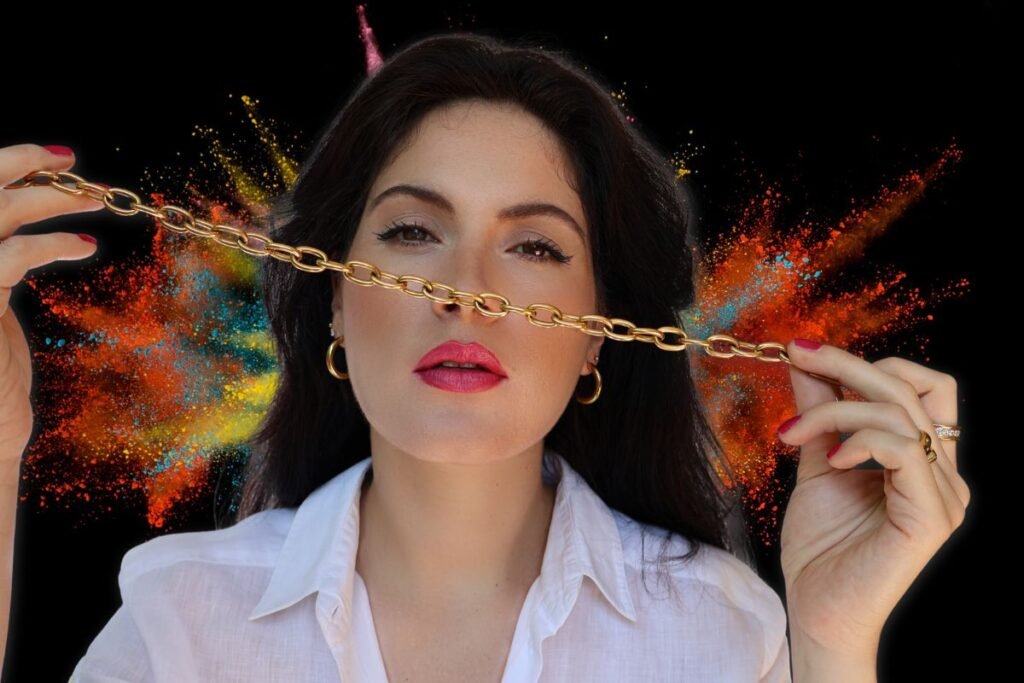
Color as Craft, Color as Compass
As a photographer, I learned early that color is never accidental. It’s shaped by light, angle, texture, and material. And that technical understanding — that reverence for nuance — became the backbone of my jewelry design and gemstone sourcing.
Synesthesia gave me the emotion of color.
Photography gave me the discipline of color.
Gemstones and jewellery gave me the purpose of color.
Now, when I pick up a stone, I don’t just look at it — I feel it in the sensory space where hue and meaning blend. And because of that inner map, I look for very specific qualities:
Color that breathes
Not artificial neon. Not over-saturated fluorescence. But hue that deepens with movement, like a living organism.
Color that carries a story
Copper-rich tourmalines that glow like candlelight. Sapphires shaped by slow geological sleep. Spinels whose reds and violets walk the line between tenderness and flame.
Color that feels inevitable
As if nature intended it from the beginning. As if no human intervention could improve or disguise it.
This is why, I study gemology by myself with the same devotion I give to the art of photography and communication..
Color is not “pretty.” Color is structural, chemical, ancient.
Every tone is the result of billions of years of pressure, heat, and chance. When you handle a gemstone, you are holding a fragment of the earth that became color the way a voice becomes music.
The Power of Nature’s Palette
Natural color has an authority that nothing synthetic can replicate. I don’t mean moral superiority — lab-grown stones have their place, and technology continues to fascinate me. But the palette of nature is not predictable. It is not engineered. It is not obedient.
Nature paints slowly, with pressure and silence.
It mixes iron into sapphire until blue becomes a state of being.
It threads manganese through spodumene until pink appears like a soft confession.
It lets chromium ignite ruby until it reaches a red that almost feels holy.
There’s a reason I return to natural stones again and again.
Not because they’re rare — though many are.
Not because they’re valuable — though many are that too.
But because they carry the essence of the earth’s imagination.
It’s incredibly hard to being able to find the perfect gradients, the perfect pair match and the perfect color saturation in multi gemstones composition. This process really fascinate me, especially the patience it requires. The hard word behind each gemstone design.
And when you place that kind of color on your skin, something ancient stirs. Something that remembers the world before noise, before speed, before disconnection.
Nature speaks through color.
Gemstones are her most articulate sentences.

How to Begin Your Own Journey Into Color
I want this journal to be a guide — not a prescription — for anyone who feels drawn to gemstones and isn’t sure where to start. You don’t need a degree. You don’t need a huge budget. You need three things:
A curious eye.
A patient heart.
And a willingness to learn the language of color slowly.
When I advise new collectors, I often begin with this:
“Choose the stone that stays with you when your eyes are closed.”
That stone is speaking to you.
Listen.
But once emotion calls you, knowledge must follow.
Here is what matters — in the simplest, most human terms:
Color is everything
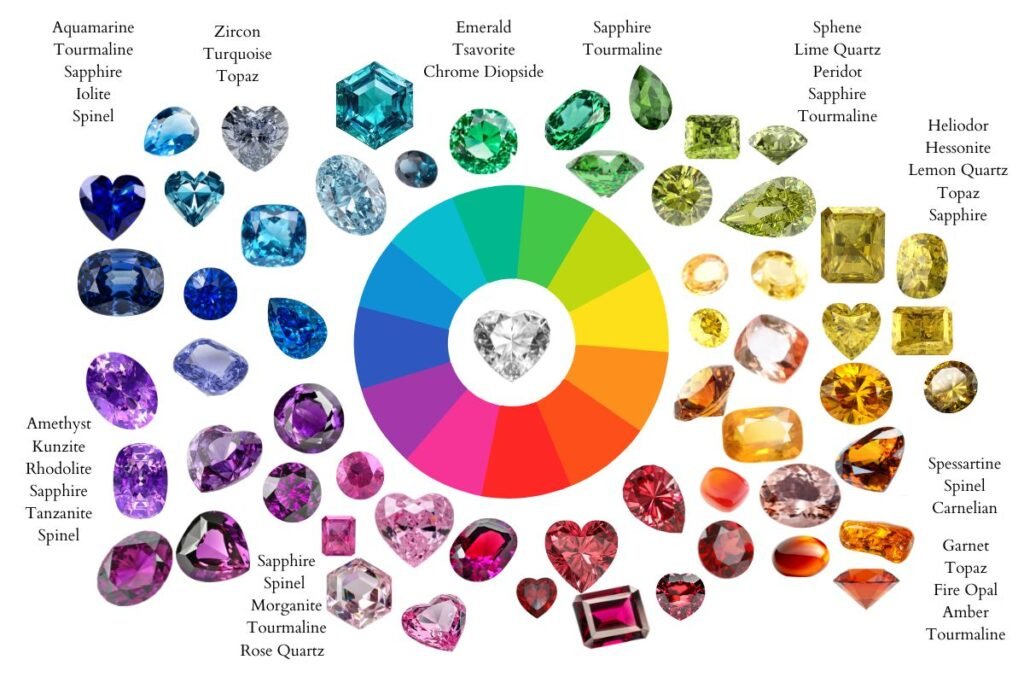
The market knows this. Cut, clarity, and carat matter — but color is the soul. Learn the difference between hue, tone, and saturation. Learn how light changes perception. Learn how your own skin alters the stone.
Cut is architecture
A great cut reveals. A bad cut hides. A stone should glow, not fight the light.
Inclusions are stories
Some are harmless. Some are beautiful. Some are structural weaknesses. Know which is which. GIA and SSEF research can teach you this — translated here into human language you can feel.
Treatments are part of the truth
Heated stones can be magnificent. Diffused stones are another category entirely. Honesty matters more than perfection. You just need to be informed on what is the gem you have in front of you.
Origin shapes personality, not supremacy
A Burmese ruby has a different character from a Mozambique ruby. That difference isn’t a hierarchy — it’s a flavor. Learn the flavors.
A collection is a portrait of you
Not a safe. Not a competition. Not a race.
Color chooses you before you choose it.
The New Age of Colored Gemstone Collecting
We’re living in a renaissance of color.
Collectors are becoming more educated. Designers are becoming braver. Younger buyers want emotional truth instead of status symbols. They want stones that feel alive, not stones that simply impress.
From Mahenge spinel to Afghan tourmaline, from mint garnet to yellow sapphire, color is reclaiming its place as the emotional center of fine jewelry.
This shift excites me.
It feels like the world is finally seeing what I’ve always seen.
Color as emotion.
Color as intelligence.
Color as lineage.
Color as connection.

The Reason I Keep Writing
Every time I study a stone — with loupe, with daylight, with my own synesthetic palette — I feel the same quiet astonishment:
How is this possible?
How is nature capable of this?
How did a planet under pressure create something so tender, so fierce, so saturated with meaning?
Gemstones remind me that nature is not just powerful — she is poetic.
And color is her most intimate language.
And this journal — this space — is my way of sharing that with you.
Not to teach you what to see.
But to help you notice the color that’s already calling you.
Because in the end, gemstone collecting isn’t about possession.
It’s about recognition.
And recognition is always an act of emotion.
My Last Thought — The Color That Lives Inside Us
I believe we’re all born with a color inside us. A tone that shapes how we move through the world, what we’re drawn to, what we trust, what we desire.
Mine has always been shifting — a brushstroke of blue, a trace of gold, sometimes a violet that arrives without warning. Synesthesia taught me to accept that internal palette instead of resisting it.
Gemstones simply made it visible, made it multi sensorial.
So if there’s one thing I want you to take away from this journal — from my work, my words, my devotion to natural color — it’s this:
Mother Nature paints in colors that teach us who we are.
When you hold a gemstone, you’re not just touching beauty.
You’re touching the earth’s memory — and sometimes, your own.
Color isn’t decoration.
Color is a form of truth. Color is a form of beauty. Embrace it.