Ethiopian Welo Opal Buying Guide
An Expert’s Guide to Evaluating One of Today’s Most Captivating Gemstones
Introduction
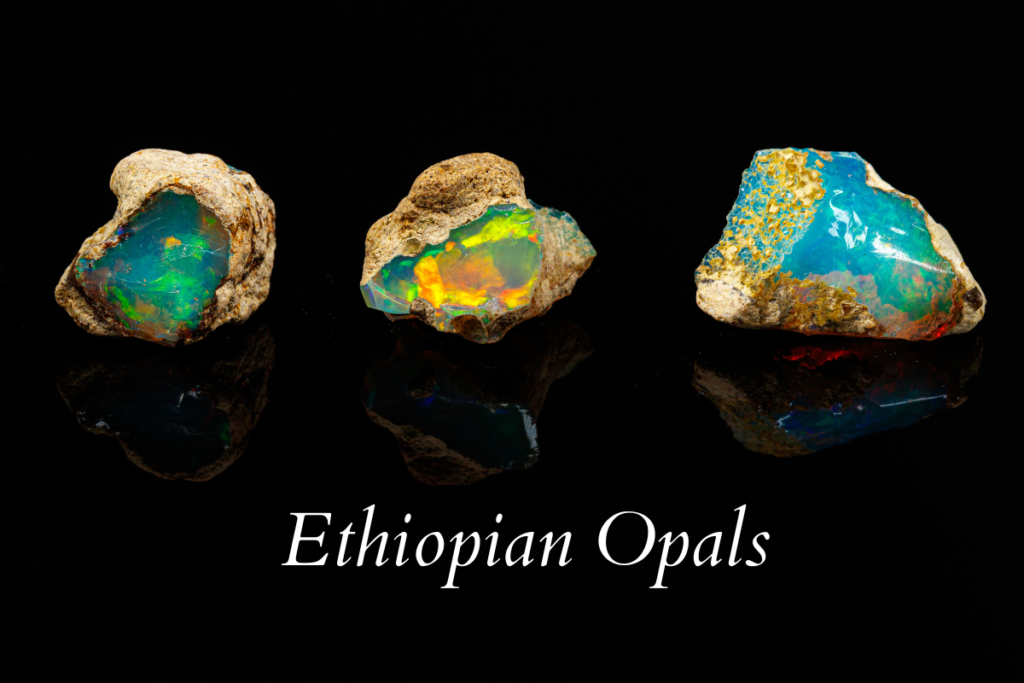
Ethiopian Welo opal has become one of the most sought-after opals of the modern era, admired for its electrifying play-of-color, its honey-like transparency, and its ability to hold vivid spectral patterns even in small sizes. This guide is written for collectors, designers, and jewelry lovers who seek to buy confidently and understand what truly elevates a Welo opal from ordinary to exceptional.
Color: What to Look For
Welo opal isn’t defined by a single palette. Its identity shifts with body tone, clarity, and internal structure — almost like personalities living inside the same volcanic origin.
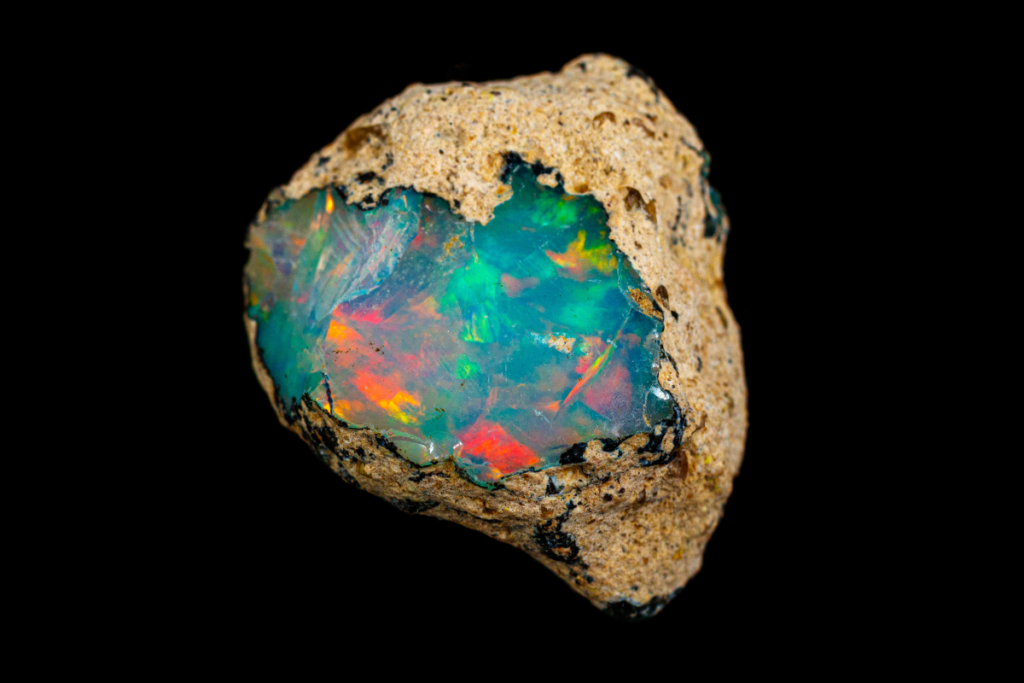
Crystal opal is the most vibrant: transparent to translucent with play-of-color floating inside like suspended light.
White opal has a softer body tone, offering bright surface flashes with a gentler mood.
Honey or amber opal brings warmth — a golden or caramel base where the fire feels deeper, as if lit from within.
Chocolate opal comes from a different Ethiopian region (Shewa). Its rich brown base has appeal, but its stability is less reliable, and collectors favor Welo material far more.
Welo opal is known for sharp, high-definition color — reds that feel heated, greens that almost go neon, violets that are rare yet unforgettable. Sometimes it mimics lightning trapped under water. Other times it resembles an oil film shifting in the sun, or a meadow of wildflowers caught in sudden wind.
Ideal Color Grades
The top Welo opals show saturated, bright color that is visible even at arm’s length. Full-spectrum stones with dominant reds and greens are especially prized. What you want is intensity that holds steady as the stone moves — not flashes that vanish the moment the light shifts.
Undesirable Tones
- Grey or smoky clouding
- Muddy or uneven patches
- Brown undertones in crystal opal
- “Dead zones” with no color
These reduce vibrancy and value.
The Language of Patterns
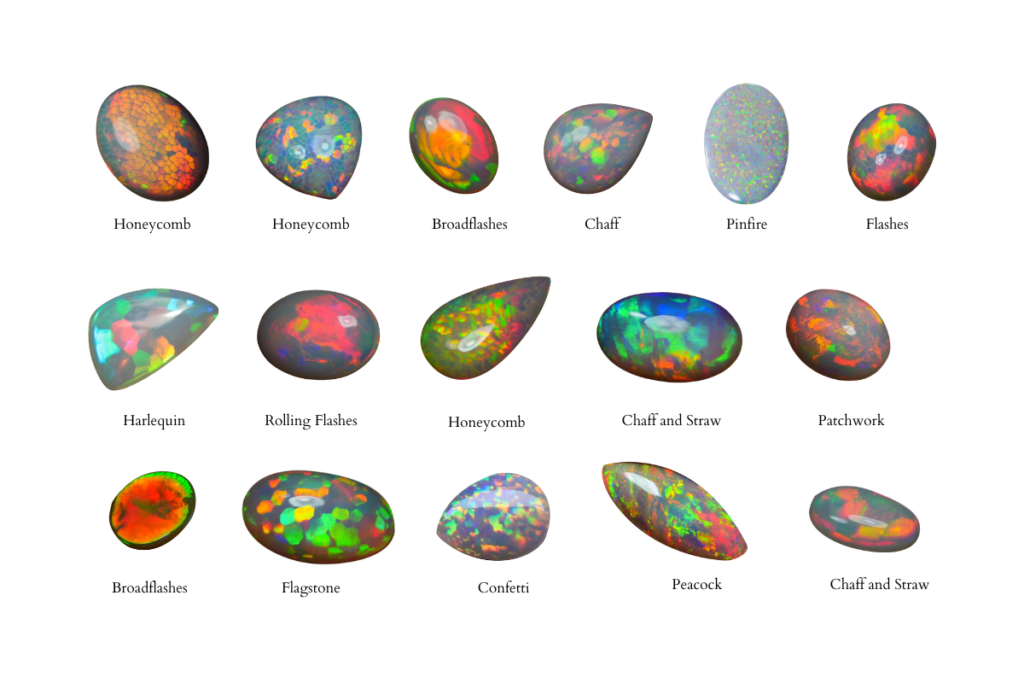
Patterns aren’t decoration. They’re structure — the arrangement of silica spheres inside the opal. And they influence value just as strongly as color itself.
These are the patterns buyers and collectors pay close attention to:
1. Honeycomb
The signature pattern of Welo opal.
Play-of-color appears in hexagonal or rounded cells that resemble illuminated honey.
Fine honeycomb with bright reds or full-spectrum flashes commands top value.
2. Harlequin (True Welo-Type Harlequin)
Very rare, but does occur in Welo material.
Large, blocky patches with crisp boundaries.
Not as geometric as Australian harlequin, but still recognizably harlequin-like when structured and vivid.
3. Mosaic / Flagstone
Broad, angular color patches with strong edges.
Common in Welo and often spectacular.
High value when the pattern is clean and evenly distributed.
4. Chaff
Small, irregular flakes of color scattered across the face.
Lively and often bright in Welo, especially in crystal opal.
5. Flag & Chaff (Hybrid)
A recognized mixed pattern in Ethiopian opal:
— larger angular patches (flagstone)
— interspersed with small flakes (chaff)
Desirable when balanced and bright.
6. Broadflash
Large sweeping sheets of color that light up the face.
Strong, saturated broadflash across multiple angles is considered fine quality.
7. Rolling Flash
A band of color that moves like a wave as the stone tilts.
Common and emotional in Welo crystal opal.
Value increases when the flash is wide and multicolored.
8. Pinfire
Tiny, pinpoint dots of color scattered like stars.
A classic opal pattern that appears frequently in Welo material.
Value depends on brightness and presence of red or violet.
9. Confetti
Medium-sized, irregular flakes resembling scattered confetti.
Often appears in crystal Welo opal and can be very lively.
10. Straw
Thin, elongated streaks or flashes resembling strands of straw.
Seen in elongated or directionally structured Welo material.
11. Patchwork
Irregular patches with soft edges — a softer cousin of mosaic.
Common, attractive, and priced based on saturation and consistency.
12. Feather / Peacock (Light Form)
Soft, layered flashes resembling feathers.
Present in some Welo crystal opals, typically blended into other patterns.
Not rare, but visually poetic and desirable in jewelry.
Pattern Quality Matters
In Welo opal, pattern clarity matters as much as the type.
A honeycomb pattern that blurs at the edges loses power.
A rolling flash that works only from one narrow angle feels restricted.
A mosaic pattern with soft or broken boundaries loses the architectural precision collectors value.
Look for consistency — a stone that performs with a steady rhythm as it moves.
Clarity: Understanding What’s Acceptable
Typical Inclusions
Ethiopian Welo opal is hydrophane and may show these natural characteristics:
- Tiny internal wisps or faint clouds
- Small internal “veils” from growth
- Subtle structure lines
These are normal and usually acceptable.
What Is Normal vs Problematic
Normal:
- Minor, soft inclusions that don’t interrupt transparency
- Subtle internal features that don’t affect durability
Problematic:
- Surface-reaching fractures
- Cloudy patches that mute color
- Deep pits or cavities
- Cracks radiating from the edges
Clarity strongly influences beauty—cloudiness reduces the strength of color play.
How Clarity Affects Value
Crystal opals with high transparency and bright, uninterrupted play-of-color are the top tier.
Any cracks or surface issues drastically decrease value.
Cut Quality: Why It Matters
Best Cuts for This Gem
Welo opals are usually cut as:
- Cabochons (most common)
- Freeform shapes
- Ovals, pear, or cushion cabochons for jewelry
- Occasionally faceted for crystal-clear material
Cabochons allow the color to bloom fully under light.
Common Cutting Issues
Watch for:
- Flat backs that make the stone appear “thin”
- Windowing (areas where the color disappears)
- Uneven dome height
- Poor polish that dulls brightness
How Cut Influences Brilliance
A well-proportioned dome magnifies color and allows the pattern to move beautifully as the stone tilts.
High-quality polish enhances luminosity and preserves transparency.
Carat Weight & Size Rarity
Common Sizes
Most Ethiopian Welo opals fall between 1–5 carats.
Crystal material tends to be lighter, so carat weight may feel larger in size than expected.
Rarity Thresholds
Rare and highly valued:
- Clean stones above 8–10 carats
- Crystal opals with bright, intense color at large sizes
- Perfect domed cabochons above 15 carats
Exceptional color in any size is always the core of value.
Value Jumps with Size
Prices rise sharply for:
- Stones over 5 carats with strong color
- Eye-clean large pieces
- Crystal material with multi-directional fire
Certification & Lab Reports
Which Labs Are Trustworthy
- GIA
- SSEF
- IGI
- Gübelin
- AGA (for U.S.-based buyers)
What a Certificate Should Include
- Identification as natural opal
- Body tone description
- Play-of-color description
- Any detectable treatments
- Weight and dimensions
- Transparency level
When Certification Is Essential
- Stones above 5 carats
- Any opal priced in the fine or collector range
- International purchases
- Custom jewelry commissions
Red Flags & Buying Mistakes to Avoid
- Strong chemical or smoky odor (sign of treatment)
- Excessive clouding after exposure to water
- Very dark body tones with suspicious uniformity
- Deep surface cracks
- Sellers who refuse natural-light videos
- Prices “too good to be true” for vivid red color
- Flat or overly thin cabochons
- Stones that look dramatically different when wet
Where to Buy (and Where Not To)
Trusted Sources
- Reputable dealers who specialize in opal
- Established gem shows
- Certified gemological vendors
- High-end online platforms with return policies
Reputable Marketplaces
- 1stDibs (select sellers)
- Gem shows (Tucson, Hong Kong, Munich)
- Trusted Instagram gem dealers with strong reputations
What to Avoid
- No-return marketplaces
- Unverified Etsy or eBay sellers
- Stones photographed wet
- Sellers who avoid discussing treatments
How to Evaluate a Stone in Person (or via Video)
Natural Light Testing
Evaluate color in indirect daylight. Welo opal thrives in soft sun.
Tilt-Test
Move the stone slowly:
- Look for continuous play-of-color
- Check if patterns shift and remain vivid from different angles
Windowing & Extinction
Avoid stones with:
- Clear patches where no color appears (“windows”)
- Dead spots that stay dark regardless of tilt
Clarity Check
Use the naked eye first. Then a loupe:
- Look for cracks, pits, or structural lines
- Ensure transparency isn’t foggy
Face-Up Color Assessment
Face-up view should show:
- Balanced color coverage
- Minimal “blank” areas
- Good dome and proportion
What Gives Spinel Its Value (Without Giving Numbers)
Collectors often focus on value. I prefer to talk about quality first, then let value follow naturally.
Still, certain characteristics influence desirability:
- Color purity and intensity — the most important factor
- Origin — Burmese and Mahenge reds, Vietnamese cobalt blues
- Clarity and cut — brilliance without windowing
- Size — exponential rarity above certain thresholds
- Lack of treatment — a major advantage over many gems
- Market demand — rising steadily as collectors turn toward connoisseur stones
The truth is that fine spinel has entered a new era. Collectors realized they were overlooking one of the world’s great natural gems. As a result, values have strengthened over the last decade — not because of trend, but because supply tightened while awareness grew. A mature market always gravitates toward integrity, and spinel has that in abundance.
Facts That Make Spinel Even More Unforgettable
A few truths I often share with clients, because they capture the soul of the gem:
- Many “rubies” in historic crown jewels are actually spinel — including the Black Prince’s Ruby in the British Imperial State Crown.
- Spinel’s chemical structure (MgAl₂O₄) gives it a crisp, sharp kind of brilliance distinct from ruby’s deeper glow.
- It occurs in colors that sapphire cannot replicate naturally — especially the neon-like pinks of Mahenge.
- Spinel is singly refractive. Its light returns cleanly, without doubling. This gives the gem a very modern clarity to the eye.
- Because natural treatments are rare, spinel is one of the most ethically transparent gems a collector can buy.
- Many of the most celebrated spinels in museums are over 500 years old — this stone ages with remarkable grace.
The more you learn about spinel, the more it feels like a gem that stood back for centuries, letting others take the spotlight, only to step forward now with quiet confidence.