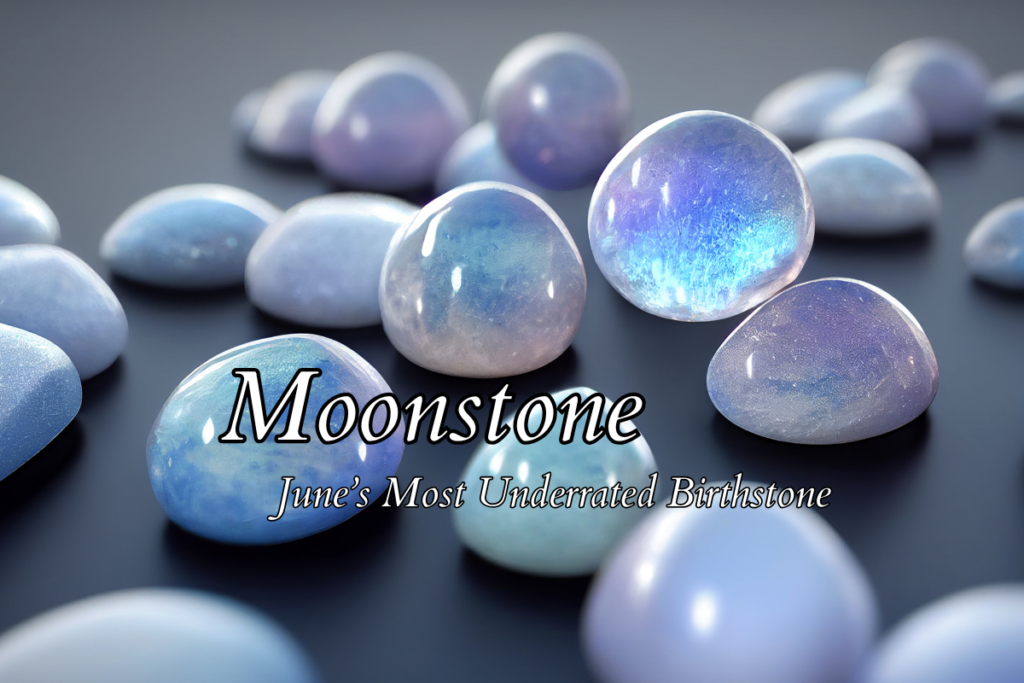
Moonstone: June’s Most Underrated Birthstone
A gemstone whose value is determined less by colour than by the way it handles light.
June occupies a curious place in the birthstone calendar.
Most months are represented by a single gem. One material, one colour, one dominant story. June belongs to three entirely different worlds. Pearl, formed by living organisms beneath the sea. Alexandrite, one of the rarest colour-changing gemstones in existence. And moonstone, a member of the feldspar family that has fascinated jewellers, gemologists, and collectors for centuries.
Of the three, moonstone is often the least understood.
Part of the confusion comes from its appearance. People expect valuable gemstones to announce themselves immediately. They expect strong colour, obvious brilliance, or dramatic visual impact. Moonstone does none of these things. In fact, some of the finest specimens can appear surprisingly restrained when viewed from the wrong angle.
Then the stone moves.
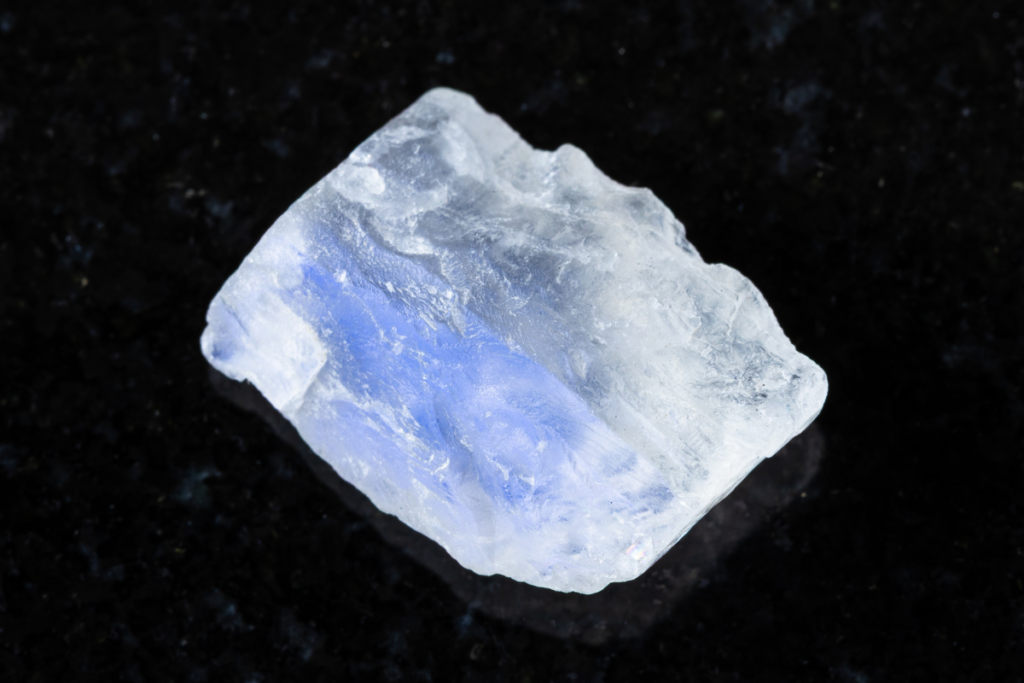
A veil of blue light begins to travel beneath the surface and suddenly the entire gem changes character.
Most people notice the effect immediately, even if they have never heard the term adularescence. They know they are looking at something unusual. The challenge is understanding why one moonstone might be worth fifty euros while another, similar in size, may be worth thousands.
The answer lies in details that are often overlooked.
Understanding What Moonstone Actually Is
Moonstone belongs to the feldspar group, which accounts for a significant portion of the Earth’s crust. On paper that sounds unremarkable. One of the most common mineral families on the planet should not produce a gemstone of particular interest.
Yet gemology rarely works that way.
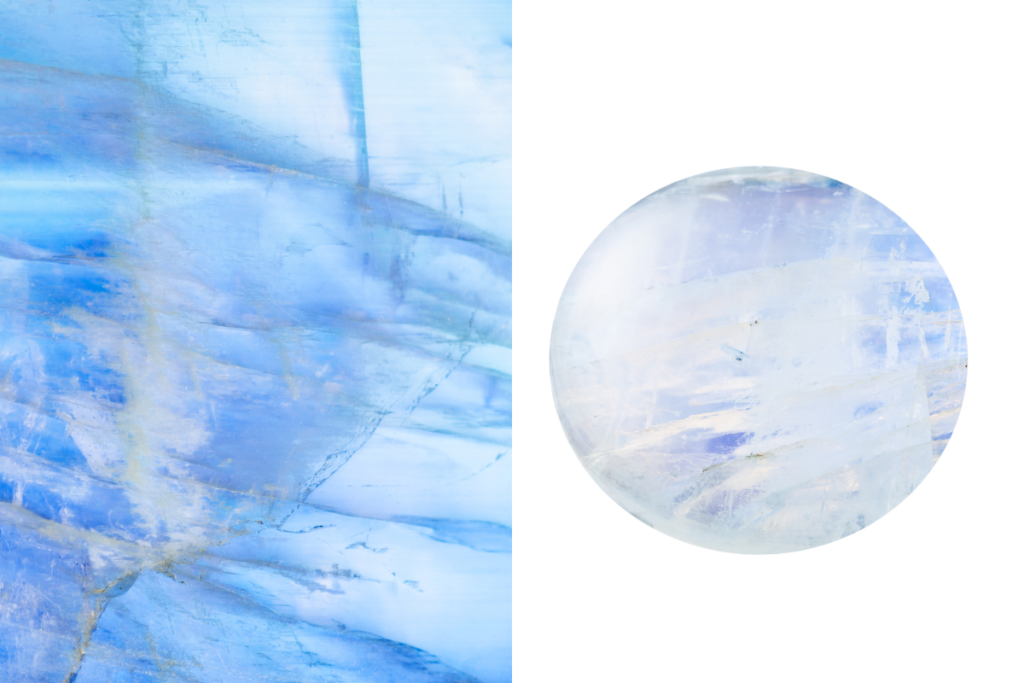
Fine moonstone forms through the intergrowth of two feldspar minerals, orthoclase and albite. As the crystal cools over geological time, microscopic layers develop within the structure. When light enters the stone, those layers scatter it in a very specific way, producing the floating glow for which moonstone is known.
This optical phenomenon is called adularescence.
The important thing to understand is that not all adularescence is equal.
Many commercial moonstones display a broad white sheen that appears and disappears as the stone moves. Better material shows a more concentrated effect. The finest specimens display a vivid blue adularescence that appears suspended beneath the surface rather than reflected from it.
That distinction is what separates ordinary material from collector-grade material.
When I evaluate moonstone, the quality of the adularescence is always the first thing I examine. Before size. Before origin. Before anything else.
Without a strong optical effect, moonstone loses the characteristic that makes it desirable in the first place.

Sri Lanka and the Search for Blue Moonstone
If there is one origin consistently associated with exceptional moonstone, it is Sri Lanka.
The deposits around Meetiyagoda have supplied the jewellery trade for generations and remain the reference point against which other moonstones are often compared.
The finest Sri Lankan specimens combine three characteristics that rarely occur together. High transparency, strong blue adularescence, and a relatively colourless body.
This combination creates the appearance most collectors are searching for. When viewed face-up, the stone appears clean and bright. As the angle changes, a concentrated blue glow emerges from within the gem.
Large examples of this quality have become increasingly difficult to source.
Mining continues, but the market today is very different from the one that existed several decades ago. Fine rough is scarce, demand remains strong, and genuinely top-grade material often changes hands before it reaches the broader market.
Other Important Sources
India has historically been another major source of moonstone, although the material tends to look different from classic Sri Lankan production.
Indian moonstones often possess softer body colours ranging from milky white to cream, peach, grey, and light brown. Their optical effects can be attractive, but they are usually broader and less concentrated than the finest Sri Lankan stones.
Madagascar has become increasingly important over the last two decades. Like many gemstone deposits discovered there, the quality range is extremely broad. Some material is commercial. Some is exceptional.
The best Madagascan moonstones can display impressive transparency combined with strong blue adularescence and are now widely used by high-end jewellers.
Smaller quantities also emerge from Tanzania, Myanmar, and parts of East Africa, occasionally producing material with unusual visual characteristics that attract specialist collectors.
The Rainbow Moonstone Misconception
One of the most common misunderstandings in the jewellery trade involves rainbow moonstone.
Strictly speaking, rainbow moonstone is not moonstone at all.
Most material sold under that name is actually white labradorite, another feldspar mineral that displays both adularescence and colourful flashes caused by a different optical mechanism.
The trade name became established because consumers recognised the visual similarity and the terminology remained.
From a gemological perspective, however, traditional moonstone and rainbow moonstone are distinct materials.
Both can be attractive. Both have a place in jewellery. They simply belong to different branches of the feldspar family.
Why Cutting Matters So Much
Moonstone is one of the clearest examples of how cutting influences value.
Unlike a sapphire or diamond, where the cutter is primarily managing brilliance and proportions, the moonstone cutter is positioning an optical phenomenon.
The internal layers responsible for adularescence must be oriented correctly relative to the finished shape. If the cutter misjudges the orientation, the glow may appear weak, off-centre, or uneven.
For this reason, moonstone is traditionally fashioned as a cabochon.
The curved dome allows the optical effect to move naturally across the stone as it is viewed from different angles. A well-cut moonstone appears alive in motion. The light shifts smoothly across the surface rather than appearing trapped in one location.
The highest-quality examples often feature relatively tall domes because this geometry tends to maximise the visual effect.
There is no universal formula. Every piece of rough behaves differently. Experience matters.
Treatments and Market Reality
Moonstone occupies a refreshing position within the gemstone market because treatments are relatively uncommon.
Most stones are sold untreated.
This does not mean every moonstone is exceptional. Far from it. The market contains enormous quantities of commercial material. What it does mean is that quality is usually determined by natural characteristics rather than enhancement.
When purchasing moonstone, I spend very little time worrying about treatment and a great deal of time assessing transparency, cutting, body colour, and optical performance.
The challenge is not identifying enhancement.
The challenge is identifying quality.
Moonstone in Modern Jewellery
The role of moonstone in contemporary jewellery has evolved considerably.
Historically it was closely associated with Art Nouveau design, where jewellers such as René Lalique embraced its soft optical character and paired it with enamel, horn, and sculptural metalwork.
Today the stone appears in a much broader range of styles.
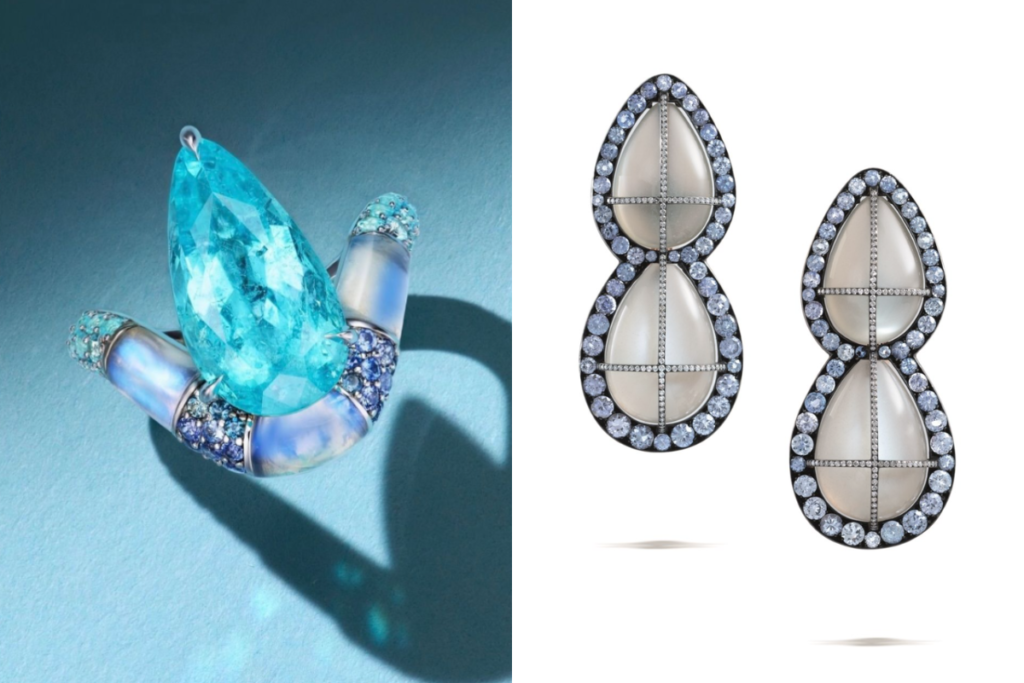
Some designers use moonstone as a centre stone in engagement rings for clients seeking something unconventional. Others incorporate it into high jewellery alongside diamonds and coloured gemstones. I increasingly see moonstone paired with brushed gold, matte finishes, and contemporary forms that allow the gemstone itself to remain the focal point.
What has not changed is the reason people are attracted to it.
Moonstone offers something increasingly rare in modern jewellery. It rewards attention.
Many gemstones reveal everything immediately. Moonstone asks the viewer to spend a little more time looking.
Perhaps that is why it remains relevant after centuries of changing tastes and fashions. The finest specimens never rely on size, rarity, or colour alone. Their appeal comes from something less obvious.
A movement of light beneath the surface.
A phenomenon created millions of years ago inside a crystal structure that no human hand could improve, only reveal.
The best moonstones remind me that some gemstones are valued not because they demand attention, but because they quietly hold it.