The Jewellery Edit: Cinema
Breakfast at Tiffany’s
Jewellery and identity, without illusion
Before getting to the jewellery, there is something the film never says out loud, but never truly hides either. In Truman Capote’s novella, Holly Golightly is clearly a high-end escort. The language is direct, sometimes crude, and the economics of her life are explicit. The film, released in 1961, could not afford that clarity. Instead, it relies on euphemism, tone, and omission.
The money from men. The paid “powder room” visits. The absence of any other form of income. None of this is accidental. In the film, Holly’s work is intuitive rather than explicit, softened rather than denied. That softening is part of the adaptation, and it changes how the story is told visually. Everything becomes more delicate. More controlled. Less confrontational.
That delicacy matters. It suggests that something in Holly’s past is not only unspoken, but actively avoided. When she says that nothing very bad can happen to you at Tiffany’s, the sentence doesn’t just describe comfort. It leaves open the possibility that something bad already has.
This is where jewellery begins to carry weight.
Tiffany’s as sanctuary, and as distance
Holly describes Tiffany’s as a place where nothing very bad can happen. She isn’t talking about safety in a practical sense. She’s talking about distance. Tiffany’s is clean, quiet, and emotionally neutral. Objects are finished, sealed, and unreachable. No one asks questions. No one comes too close.
For someone whose life depends on controlled proximity, that matters.
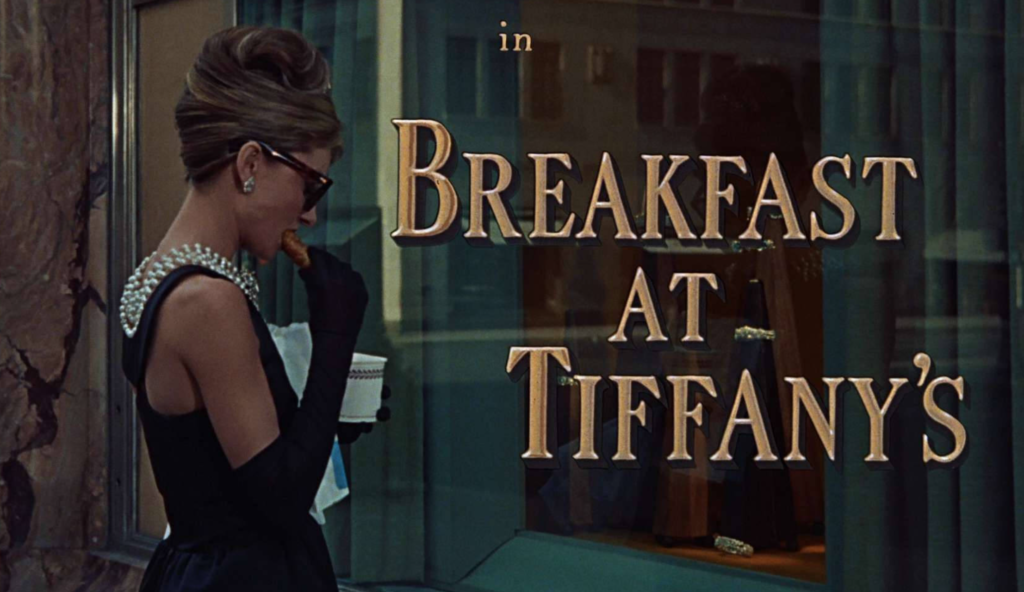
Holly doesn’t go there to buy jewellery. She goes there to stand near a world that feels contained and impersonal. A world where desire is suspended and intimacy is not required. The opening scene makes this clear. She stands outside, alone, eating nothing, touching nothing. Tiffany’s functions as a mental refuge, not a destination.
It is order without exposure.
Jewellery the missing link between instability and control
Holly’s instability isn’t dramatic or accidental. It’s practical. She depends on attention to survive, but emotional exposure would put her at risk, so she learns to stay close to people without letting them get close to her. Jewellery helps her do that.
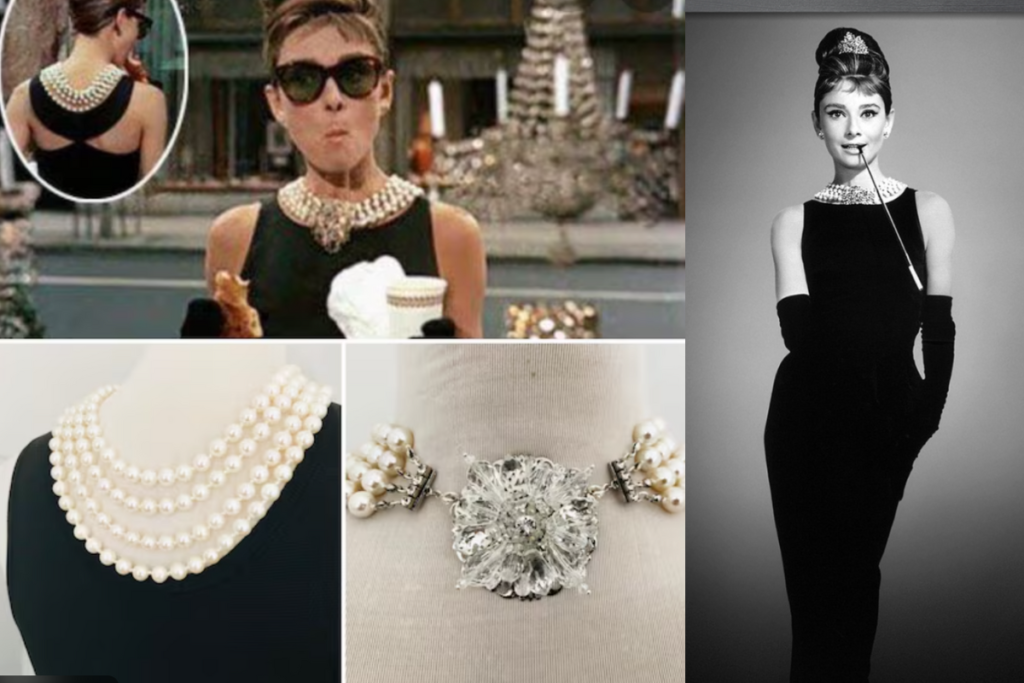
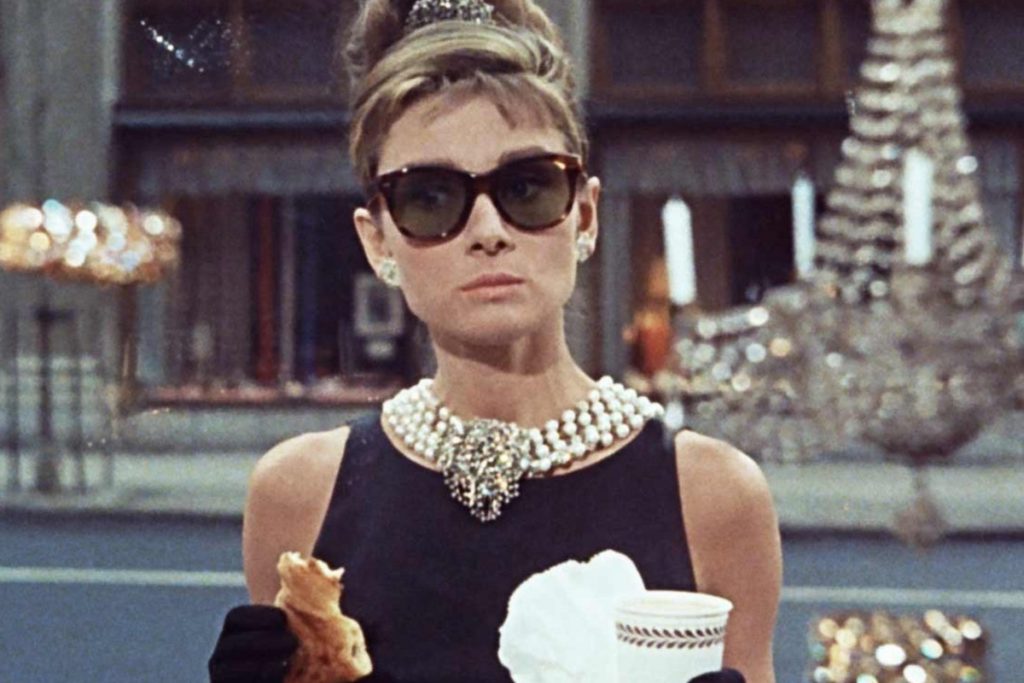
The pearl necklace appears again and again, worn in the same way, at the same height, doing the same work. It doesn’t shift with her mood. It doesn’t react to what’s happening around her. When her circumstances change, the necklace doesn’t. That repetition gives her a surface she can rely on.
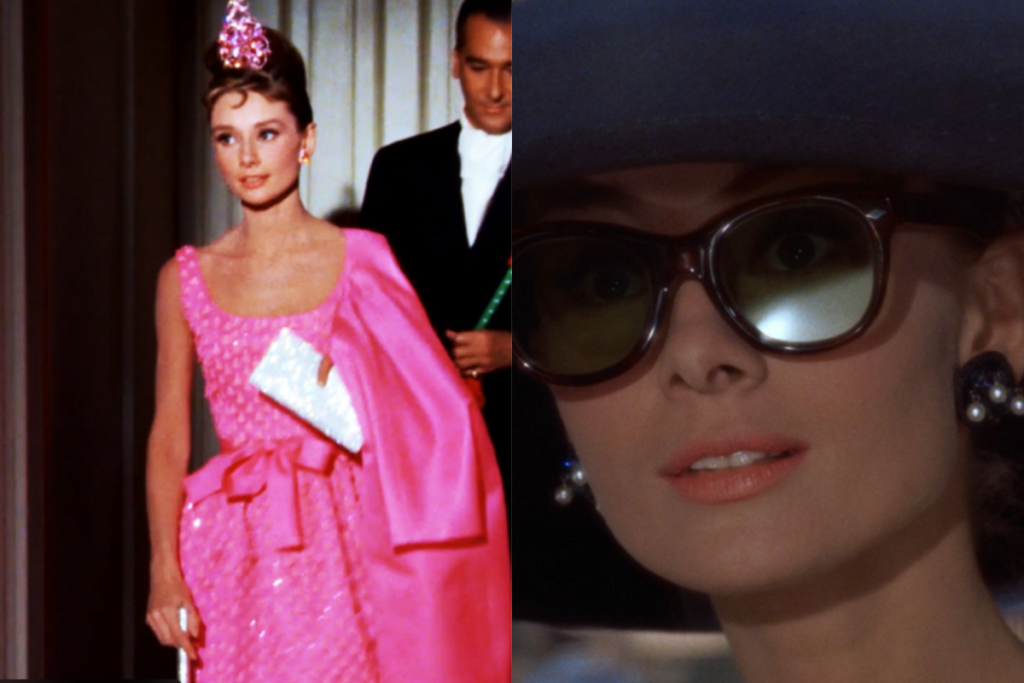
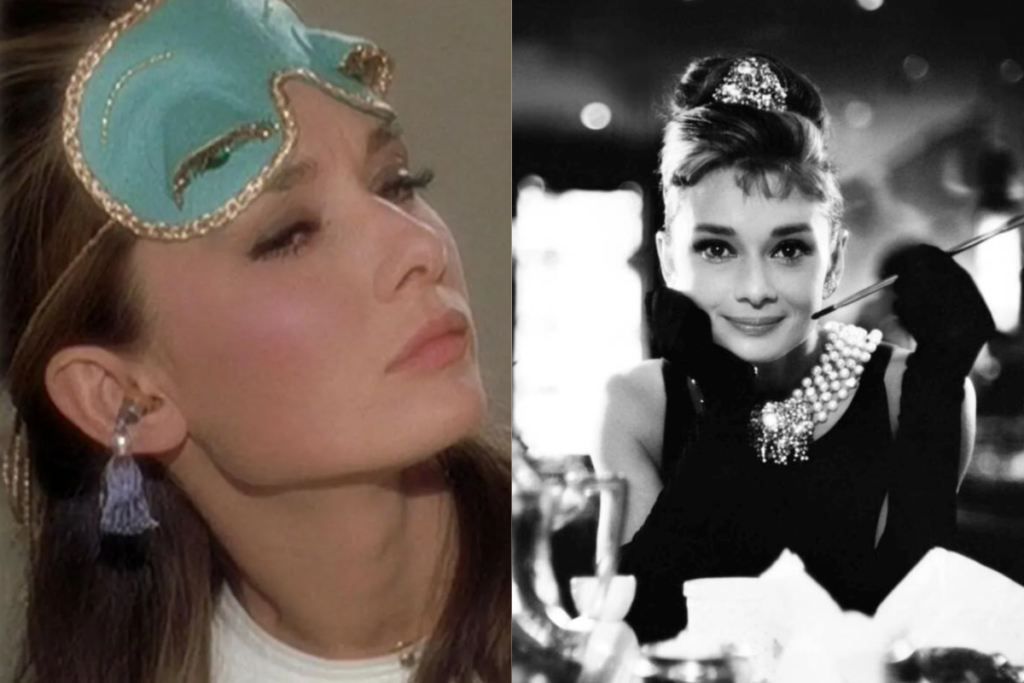
The brief appearance of the tiara makes this clearer. It’s louder, more explicit, and less stable. It sits on her rather than with her, and you feel the effort behind it.
Jewellery here isn’t about status or belonging. Holly moves through elegant rooms, but she never settles into them. Other characters—Paul, Doc Golightly—wear little or no jewellery, and their emotional state is visible. Holly’s isn’t. Jewellery doesn’t lift her above anyone else. It keeps her separate, and that separation is what allows her to keep going.
The pearl necklace: heritage without inheritance
The central piece is the multi-strand pearl necklace. Short, worn high on the collarbone, composed of small, evenly matched pearls—most likely cultured Akoya. The pearls are round and consistent, with a cool cream tone and tight, even luster. At roughly six to seven millimetres, any flaw would be visible on screen. These pearls are carefully selected.
The construction is disciplined. Several short strands aligned closely, no visible clasp, no central motif. The necklace moves very little. It behaves like a surface rather than an ornament.
Pearls traditionally suggest inheritance, continuity, and family structure. They are often passed down, worn at moments that mark entry into adult life. That context matters here, because Holly has none of it. She wears pearls without inheritance. Heritage without origin. They allow her to project a sense of stability and background that her life does not actually provide.
The necklace doesn’t describe who she is. It supports who she needs to appear to be.
The tiara: when control becomes visible
The diamond tiara appears briefly, most notably during the party scene. It plays a different role. It is theatrical and explicit, and it feels less integrated into her body. It sits on her head rather than moving with her posture. It looks borrowed.
Where the pearls stabilise the image, the tiara exposes effort. It shows what happens when surface control becomes visible. The image still holds, but it tightens. The contrast with the pearls is deliberate.
Earrings, hierarchy, and restraint
Earrings appear occasionally and are always secondary. Small, controlled, never competing with the necklace. The hierarchy is clear. The necklace anchors the image. Everything else supports it.
Nothing accumulates. Nothing spills over.
Rings, and why they are absent
Rings are notably absent from Holly’s jewellery language, and this absence is telling.
Rings imply permanence, commitment, and ownership. They suggest a private sphere and exclusivity. High-end escorts do not wear rings because rings collapse ambiguity. They suggest attachment and belonging.
Holly avoids all of this. Psychologically and practically, rings would contradict the life she is managing. Her jewellery never closes a circle. Everything remains open, negotiable, and unfinished.
Book versus film: why the jewellery matters more on screen
Capote’s Holly is sharper, more exposed, and less protected by softness. The film chooses another route. It replaces bluntness with restraint. What is said directly on the page is suggested through surface on screen.
That is why jewellery becomes so important in the cinematic version. It carries what cannot be spoken. It replaces explicit language with controlled appearance. The pearls, the tiara, the absence of rings—all of it communicates without explanation.
The camera participates in this choice. Light is even. Movement is restrained. Nothing is allowed to become too raw. That delicacy doesn’t deny harm. It hints at it.
Who made the necklace, and why anonymity matters
The wardrobe for the film was designed by Hubert de Givenchy, Audrey Hepburn’s long-time collaborator. The pearl necklace was selected as part of the costume rather than presented as a signed jewel. There is no confirmed attribution to Tiffany & Co. or any other jewellery house.
That anonymity matters. Recognition would introduce provenance, history, ownership. The necklace needs none of that. It exists to serve the character and the frame.
Whether the pearls were technically real or costume is secondary. On screen, they behave like fine pearls. They hold light evenly. They remain consistent across scenes. They do not call attention to themselves.
When Jewellery Becomes an emotional scaffolding
Holly Golightly constructs herself continuously. She edits her past, controls access to her body and emotions, and decides how close anyone is allowed to come. Jewellery supports that construction by giving her a stable exterior when her inner life is unstable. The pearl necklace does not respond to fear, uncertainty, or attachment. It stays in place. When relationships shift or collapse, the necklace behaves exactly the same way. That consistency matters. It gives her a surface she can rely on when nothing else is reliable. Jewellery does not save her and it does not protect her from consequence, but it allows her to keep functioning. When things fall apart, the pearls remain unchanged, and that unchanged surface is what keeps her upright.
This is precisely why the film still feels contemporary. The mechanism hasn’t changed. Today, many people build their identity around objects, brands, and carefully curated aesthetics not to gain status, but to manage instability. Profiles, wardrobes, jewellery, and interiors become fixed points in lives that are otherwise fluid, uncertain, and exposed. Like Holly’s pearls, these objects are expected to behave consistently when everything else shifts. The difference is not psychological, but cultural. Where Holly used jewellery to remain unreadable, contemporary culture often uses it to be seen. The function, however, is the same: external structure compensating for internal uncertainty.
By the final scenes of Breakfast at Tiffany’s, when control loosens and emotion surfaces, the necklace is still there. Same position. Same behaviour. It doesn’t resolve Holly Golightly or explain who she is. It shows how she stays intact in a world that offers very little permanence.